On this page
ONE FURNITURE DESIGN. THREE SURFACE ROUTES.
Choose the finish around the piece your customer will use.
HPL faced MDF uses a separate high-pressure laminate bonded to the board; melamine faced MDF uses resin-treated decorative paper fused to the substrate; PVC faced MDF uses an applied decorative foil. These are different surface constructions to compare on the same furniture component. Select the face, MDF grade, reverse and edge together, then review the finish and processing route on a complete working sample.
CUZI supplies all three surface routes, with single- and double-sided arrangements. HPL faced MDF is available in 12–25 mm finished thickness with 0.5–2 mm HPL; a single HPL front can have a melamine reverse. Send your decor reference and drawing to discuss a complete panel and a finished sample.
A furniture set can combine more than one surface successfully when each part has a clear role. Give working surfaces their contact and cleaning requirements, fronts their appearance and profile, and cabinet interiors their decor and edging schedule. Compare the complete delivered part with the operations that remain in your workshop.
HPL, melamine and PVC describe different surface constructions.
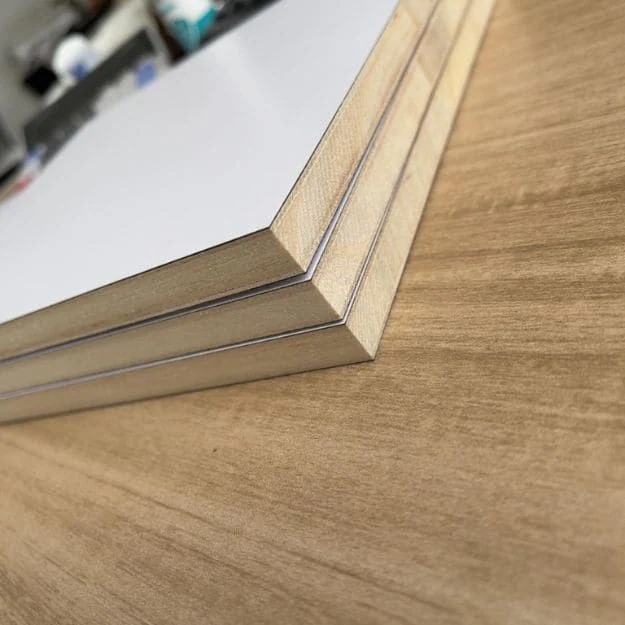
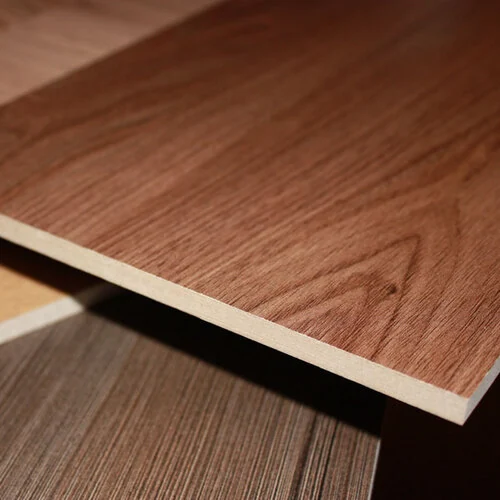
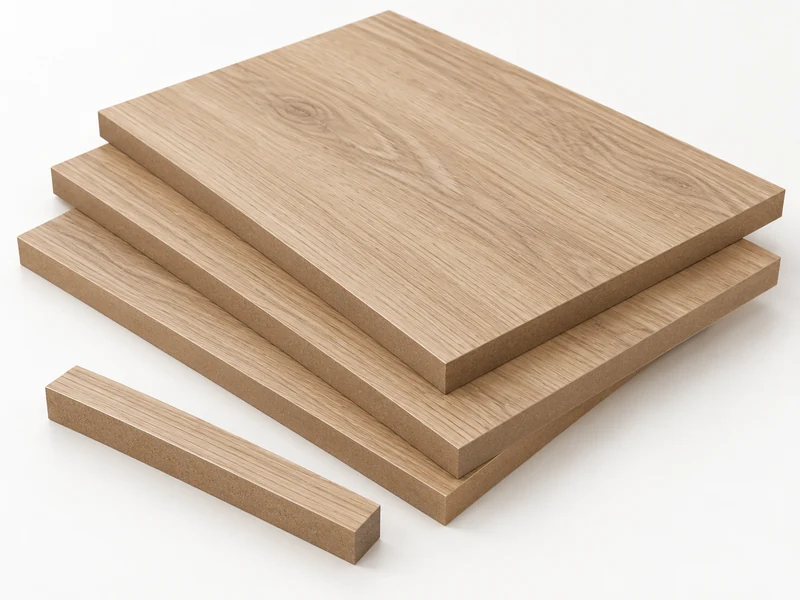
Keep “laminated MDF” connected to a named facing material. The layer schematics show the three construction routes; the quotation defines the actual layers, gauges and finished thickness.
The ICDLI HPL product guide describes a resin-and-paper laminate made as a separate sheet. The Composite Panel Association's TFL guidance explains decorative paper fused directly to a substrate, commonly called melamine facing.
For PVC, the European Panel Federation's foil guidance describes MDF as a substrate for decorative film. Its membrane-pressing guidance also discusses film formed over machined profiles. Specify the proposed film and process for the actual geometry.
Explore the individual supply routes on HPL Faced MDF, Melamine MDF Board and PVC Faced MDF. Use Laminated MDF when comparing a broader facing requirement.
Keep the substrate visible in the material description.
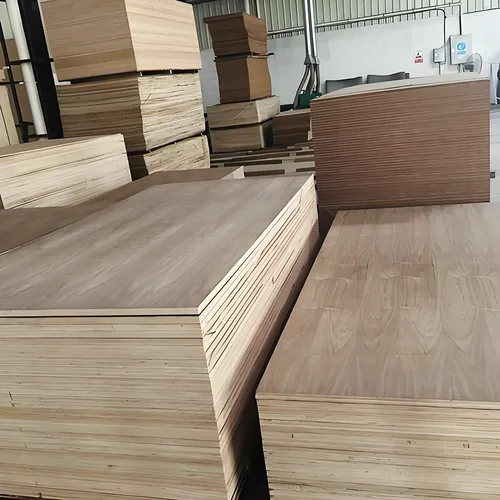
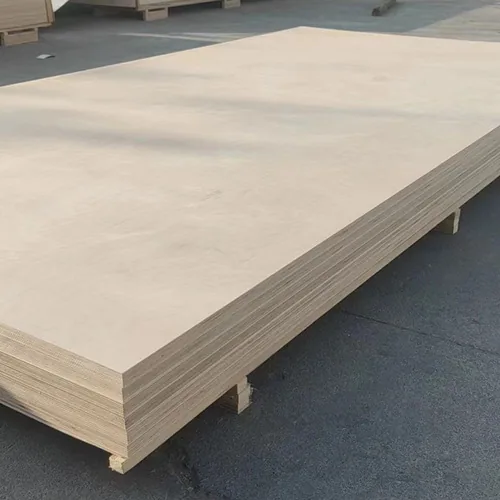
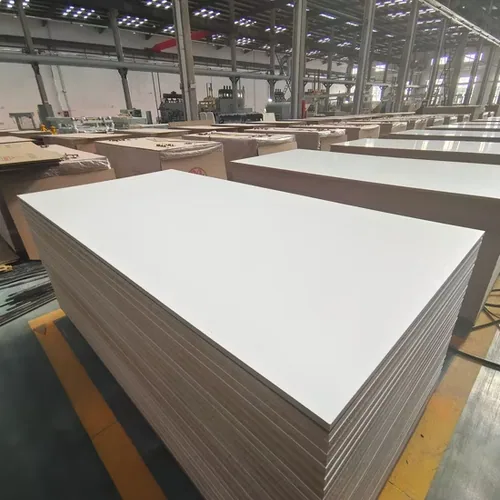
The HPL photograph shows white faces and MDF core edges; the melamine photograph shows a woodgrain face and pale board edges; the PVC photograph shows light woodgrain film and brown fibreboard cut edges. Use the named panel construction with the decor reference. The layer diagrams explain the surface routes, while the supplied model and documents identify the actual materials, bonding and performance.
An HPL sheet bonded to MDF includes a separate laminate and bonding arrangement. A melamine-faced sheet needs its front/reverse paper and substrate identities. A PVC-faced sheet or formed front needs the selected foil, adhesive and process. Keep that construction beside the physical finish you choose.
Let the furniture detail decide what you compare.
Scroll horizontally to compare all columns.
| Component | Surface route to discuss | Include with the comparison |
|---|---|---|
| Flat carcasses, wardrobes and shelving | Melamine faced MDF, with coordinated HPL or film fronts where required. | Visible faces, decor/texture, cut edges, fittings and the ready-to-machine scope. |
| Furniture and working surfaces | HPL faced MDF with the laminate grade selected for the use. | Wear, impact, cleaning and any heat/moisture exposure, with edge and cut-out details. |
| Profiled furniture fronts | PVC film and the requested forming/bonding process; compare the actual profile. | Section drawing, radius, recess, corners, reverse and finished-part trial. |
| Coordinated interiors and door sets | A named surface for each front, interior and neighbouring component. | Physical decor references, sheen, direction, edge and assembly viewing conditions. |
For a curved HPL edge, send the radius and forming requirement with the laminate inquiry. For a wrapped or membrane-formed PVC detail, send the profile and requested film. Agree the proposed grade and process on that drawing before choosing the finished reference.
Use the same dimensions and acceptance criteria when comparing alternatives. Record which operations your workshop will perform and which you want included before delivery. A sheet, an edged blank and a completed door are useful separate quotation scopes.
Map a coordinated set before comparing its prices.
Quantity calculation assumptions: 40 cabinets, each with two 700 × 400 mm doors, two 720 × 560 mm sides and three 560 × 500 mm shelves. Doors are compared as HPL or PVC fronts; sides and shelves are melamine-faced. Areas use rectangular part dimensions before cutting losses and allowances.
Scroll horizontally to compare all columns.
| Component | Total parts | One-face area | Both-face area |
|---|---|---|---|
| 700 × 400 mm doors | 80 | 22.40 m² | 44.80 m² |
| 720 × 560 mm sides | 80 | 32.26 m² | 64.51 m² |
| 560 × 500 mm shelves | 120 | 33.60 m² | 67.20 m² |
| All components | 280 | 88.26 m² | 176.51 m² |
If the doors use one HPL front and a melamine reverse, their net face requirements are 22.40 m² of HPL and 22.40 m² of melamine. Both sides of the carcass parts add 131.71 m² of melamine, giving 154.11 m² of melamine facing overall from unrounded calculations. A PVC alternative keeps its own front/reverse construction and delivered stage.
These are part surface areas, not the purchased facing-sheet quantities. Add actual sheet formats, pattern direction, cutting layout, forming allowances and process waste to obtain the material order. Keep those additions identifiable when comparing quotations for the same cabinet set.
Select the surface at the detail that matters most
Use the part drawing to narrow the route, then compare actual offered models. Keep appearance, use conditions, processing and finished fit together when an alternative is proposed.
Scroll horizontally to compare all columns.
| Component or input | Compare | Select with |
|---|---|---|
| HPL on a flat work surface | Selected laminate grade/gauge and actual wear, impact, cleaning or heat requirement; MDF, adhesive, reverse, joint and cut-out. | Full construction data and the finished edge/corner. A curved detail requires the appropriate laminate grade and supplier forming instructions. |
| Melamine on flat furniture parts | TFL face/reverse and substrate grade, decor/texture/sheen, cut quality, edging and hardware. | The machined and edged component. Specify any finish added where a cut exposes the substrate. |
| PVC on flat or profiled fronts | Film model/gauge and actual flat-lamination or forming route, adhesive, recess/radius/corner, return and reverse. | The completed local profile/edge and fitting trial using the proposed materials and process. |
CUZI supply options: name the face and finished panel.
Scroll horizontally to compare all columns.
| Surface route | Supply information | Define for the item |
|---|---|---|
| HPL faced MDF | 12–25 mm finished panels; 0.5–2 mm HPL. Single or double HPL faces; melamine reverse available for a single HPL front. | HPL grade, decor and layer thickness; MDF core, reverse, total thickness and edge. |
| Melamine MDF | Single- or double-sided supply; black, white or woodgrain decor requirements. | Selected decor/master, texture, sheen, substrate, finished thickness and matching edge. |
| PVC faced MDF | Single- or double-sided supply; finished thickness, film gauge, decor and reverse discussed with quotation. | Film identity, finish reference, MDF/bonding construction and flat or formed detail. |
HPL decors and surface effects follow our melamine range. Review the proposed physical references beside each other when combining systems in one furniture set. Keep the actual laminate, paper or film reference on each item.
Regular HPL finished-panel sizes are 1220 × 2440 mm and 2100 × 2800 mm. Requested sizes include 1220 × 3050 mm, 1830 × 3660 mm and 1220 × 3660 mm. Include the facing reference and complete layer arrangement with the selected format.
Distinguish MDF core thickness from finished panel thickness, and state the tolerance at the feature that must fit. Where you want a particular substrate grade or emission option, identify it with the surface construction and the destination documents.
Make the finished thickness a dimension of its own.
For a double-HPL construction, an assumed 18 mm substrate with 1 mm laminate on each side has a nominal layer sum of 20 mm before the bonding contribution. The actual finished dimension and tolerance belong on the quotation and working-part drawing. This layer calculation is separate from CUZI's 12–25 mm finished-panel range.
Mark any fitting that depends on completed thickness, including a hinge recess, groove or adjoining panel. State which face is the datum for drilling and machining. If the reverse or facing changes, review the completed dimension with that construction rather than carrying over the earlier board gauge.
Put the reverse and edge on the same drawing as the face.
Show which sides are visible, which reverse will sit inside the cabinet and where cut edges remain exposed. Specify the front and back materials, finish references, adhesive/bonding arrangement and finished thickness. Review flatness on the actual door or panel size.
A single HPL face with a melamine reverse is one CUZI supply arrangement. For double-sided HPL, identify both laminate references. For melamine or PVC, specify the selected treatment of each side and the expected view of the assembled piece.
Give the edge band, lipping or requested wrapped detail a reference of its own. Include the edge thickness, colour/texture, corner and joint treatment, with the dimensions of the completed part. The decor and edge matching guide helps organise that approval.
For openings, hardware recesses or an exposed cut-out, mark the finished detail on the drawing. Ask how the included processing, bonding and edge treatment will be supplied. Retain that detail with the representative sample your team evaluates.
Count the edge treatment by the finished detail.
For the cabinet calculation, edging all four rectangular door edges gives 80 × 2 × (0.70 + 0.40) = 176 m before allowances. One visible front edge on each side gives 57.60 m, and one on each shelf gives 67.20 m. Their combined rectangular edge run is 300.80 m.
Use those lengths only for the selected banded-edge route. A wrapped PVC profile needs the film coverage, forming allowance, corners and bonding process from its actual section. A shaped HPL edge needs its laminate grade, radius and requested processing. Keep banded, lipped and wrapped alternatives as distinct operations in the costing.
Reserve the finished thickness before choosing the core
For a chosen 18 mm finished target, subtract the specified face and reverse to find the remainder available for MDF and bonding layers. The numbers below are geometry inputs; only the HPL supply range is a confirmed product option. Obtain actual complete-layer gauges and measurements for each offer.
Scroll horizontally to compare all columns.
| Component or input | Compare | Select with |
|---|---|---|
| HPL 0.8 / HPL 0.8 mm | 18 − 0.8 − 0.8 = 16.4 mm for MDF plus bonding layers. | Actual core, adhesive, laminate and measured finished thickness at the component checking stage. |
| HPL 0.8 / chosen melamine 0.1 mm | 18 − 0.8 − 0.1 = 17.1 mm remaining. The 0.1 mm is a calculation input for this reverse. | The offered reverse construction and balancing/laminating instructions with the actual finished panel. |
| Chosen film 0.3 / film 0.3 mm | 18 − 0.3 − 0.3 = 17.4 mm remaining. These film gauges are calculation inputs. | The proposed film/bond/core stack and resulting profile, hinge or connector fit. |
A remainder is not a stocked core size. Keep manufacturing tolerances, sanding or profile work, bonding and measurement conditions with the offered total. Use the actual finished sample for adjoining panels, hardware pockets and recesses. CUZI HPL options remain 12–25 mm finished panel and 0.5–2 mm HPL, quoted with the chosen reverse and construction.
Choose a physical decor reference your team can repeat.
Send a decor code, branded reference, photograph or physical master to start the discussion. Compare the proposed face, reverse and edge in the lighting and viewing arrangement of the furniture. Mark grain direction across adjacent doors or drawer fronts.
Record shade, pattern scale, texture and sheen separately. A matching print across surface systems can still require a physical comparison of the finished materials. Keep the accepted references beside the chosen construction and item code.
- Identify each surface material and decor/master reference.
- Place the proposed front beside the reverse, edge band and neighbouring panel.
- Review direction, visible joints and the planned lighting or viewing distance.
- Record the agreed appearance criteria and any required gloss method/angle.
- Keep the selected physical references with the repeat-order schedule.
For a reflective finish, use the high-gloss MDF brief to identify the actual surface system and viewing conditions. If the requirement names PET, use the PET facing route with that material identity in the order.
Review the joint your customer will see.
Place the proposed door beside its carcass interior, exposed side and edge. Show the grain direction on the elevation and identify any adjacent pieces that need a coordinated view. Record the accepted physical references for each surface system even when their printed decor names match.
Include the production finish and cleaning instructions with the appearance comparison. For a textured or reflective face, view the actual edge junction, corner and neighbouring panel under the intended lighting. Keep any change of material or finish reference with the part code used for a repeat order.
Request the properties of the offered model.
Include the intended use and the customer's test requirements with the selected laminate, paper or film. Where the specification names HPL under the EN 438 series, identify the required part, edition and grade with the quoted model.
Scroll horizontally to compare all columns.
| Buying requirement | Request with the model | Keep with the finished construction |
|---|---|---|
| Wear, scratch or impact | Named method, tested reference and relevant results/criteria. | Actual face, laminate or film gauge and intended contact. |
| Cleaning, staining or chemical contact | Specified substances, exposure/test method and care instructions. | Face, edge, joints and the proposed cleaning routine. |
| Heat, moisture or forming | Applicable model/process data and the required conditions. | Substrate, adhesive, radius/profile, reverse and finished detail. |
| Emission or fire requirement | Relevant material and finished-system reports or assessment. | Proposed substrate, facing, bonding, complete construction and destination. |
| Appearance and dimensions | Decor/master, sheen method where required, finished tolerance and flatness criteria. | Full panel/part size, visible sides, grain direction and accepted sample. |
Keep an industry surface description connected to the proposed supplier model and its documentation. Request the applicable substrate and complete-panel information with the surface data. Our US and EU emission-document guide helps define the market file for the board and finished article.
Describe exposure at the edge and opening too.
For a working surface, show where liquid, heat, cleaning substances or impact may reach a joint, cut-out or unprotected edge. Send the relevant customer requirement with the offered face model. Review the substrate and bonding arrangement with that detail so the finished-panel discussion includes the areas beyond the main face.
Keep test method, tested model and construction readable with any supplied performance result. A surface data sheet helps select a facing, while the completed component also depends on its substrate, reverse, adhesive, edge treatment and use. Ask for the file that addresses the selected delivered scope.
Compare the completed trial through four buying decisions
Use one component requirement and retain the relevant observation for each proposed surface. Request model-specific methods and criteria for performance requirements; define the finished feature and use before interpreting a result.
Scroll horizontally to compare all columns.
| Component or input | Compare | Select with |
|---|---|---|
| Appearance at the junction | Face/reverse/decor codes, direction, edge material, seam/corner and adjoining surface under project lighting. | Retain the selected physical references and note any accepted difference across surface systems. |
| Machining and covering | Actual cut/profile/radius, forming or bonding route, adhesive/material instructions, completed edge and supplied stage. | Retain the local trial result, responsible operation and outstanding work with the drawing issue. |
| Cleaning and service | Real contact, cleaning substances/routine, temperature/moisture conditions and relevant model method/results/care. | Choose the actual tested material/system scope for the job; keep open requirements attached to the component. |
| Fit and reproduction | Finished dimensions/flatness checking conditions, actual hardware, material and process revision, repeat decor or spare sequence. | Keep the selected full component and required receiving checks linked to the quoted item. |
Compare quotations for the same finished item.
Give each surface option its own line while retaining the shared part code, drawing revision and quantity. Name the face/reverse, MDF grade, layer and finished thicknesses, dimensions, edge work and delivered processing. Include the document and sample requirements with that line.
Record what remains for your workshop: cutting, routing, edging, drilling, forming or assembly. Compare usable output and preparation through the process you intend to run. Keep any changed geometry, finish or included operation visible in the alternative offer.
Start a quotation through the HPL item outline, melamine item outline or PVC item outline. Add the decor/master, quantity and named FOB or CIF port so the response follows the same supply scope.
Compare at the point where your workshop receives the part.
Scroll horizontally to compare all columns.
| Delivered stage | Identify in the offer | Cost after receipt |
|---|---|---|
| Faced full sheets | Format, complete layers, front/reverse and delivered finish. | Cutting layout, edging, holes, profile work and assembly. |
| Edged rectangular blanks | Final or pre-finishing dimensions, selected edges and decor direction. | Remaining drilling, fitting, finishing and assembly. |
| Profiled or formed fronts | Drawing revision, film/laminate model, process, reverse and completed detail. | Any outstanding fitting or finish work and assembly. |
Compare included material, processing, packing and freight on the same basis, then add the workshop operations still required. Record accepted part output from the relevant trial and divide the included cost by that quantity. Keep any changed part geometry or finish visible on the alternative line.
Give each surface its own supplied-work line
A coordinated cabinet can use an HPL working surface, melamine interior and PVC front. The design can share an appearance brief while the offered constructions and delivered stages remain distinct.
Scroll horizontally to compare all columns.
| Component or input | Compare | Select with |
|---|---|---|
| HPL working surface | Finished panel/model, front/reverse, core/bond, selected edges/cut-outs and included fabrication. | Actual finished part or full sheet identified separately, relevant surface/care files and remaining installation work. |
| Melamine interior | Substrate designation, front/reverse decor, grain, final or blank dimensions, selected bands and boring. | Item quantities and complete-set allocation with the selected decor/edge/hardware reference. |
| PVC front | Flat or formed construction, film/adhesive/core/reverse, profile and actual covered/trimmed dimensions. | Clearly quoted sheet, uncovered blank or completed covered-part stage with remaining work. |
| Shared shipment | Distinct item/revision, parts or sheets, lot/pack identity, protection and named FOB/CIF port. | Separate charges and supplied quantities; agree the actual material/processing/dispatch readiness for each line. |
SEE THE FINISH ON THE PART YOU WILL BUY
Request a finished HPL, melamine or PVC MDF sample.
The sample routes retain the selected surface material and fields for the decor reference, texture/sheen, finished thickness, front/reverse and working edge. Add a physical master or send the drawing/finish files by email with the same inquiry reference.
For a cabinet door, profiled front or coordinated set, request the sample format that demonstrates the critical face, reverse, edge and fitting. Keep your observations and chosen physical reference with the proposed construction for the order.
CUZI orders start at one container, with mixed loads available. Regular production takes 10–15 days, with shipping additional; agreed fabrication and testing are scheduled with the quotation. Samples are free; the buyer pays freight, with a later-order freight credit available by agreement.
Send the selected finish into the order record.
After comparing the finished references, identify the chosen face, reverse, edge and substrate under each part code. Return the critical dimensions and the observations from your fitting, machining and finish trial. This lets the quotation follow the combination your team evaluated.
For mixed orders, provide a schedule of part quantities, surface references, packing groups and the named FOB or CIF port. State the target receiving date and any required document deadline. Keep the corresponding finish references available to purchasing and receiving for the next batch.
HPL, melamine and PVC faced MDF questions.
How do HPL and melamine faced MDF differ?
HPL uses a separate laminate sheet bonded to the MDF. Melamine facing uses decorative resin-impregnated paper fused directly to the substrate. Identify the actual surface model, reverse and finished thickness when comparing panels.
What HPL MDF thicknesses can CUZI supply?
HPL faced MDF is available in 12–25 mm finished thickness with 0.5–2 mm HPL, on one or both sides. A single HPL face can be paired with a melamine reverse.
Can PVC be considered for a profiled furniture front?
Send the profile section, radius, film requirement, reverse and intended forming/bonding process. Review the proposed model and a representative finished detail with its dimensions and required performance.
Can HPL fronts coordinate with melamine interiors?
Yes. CUZI HPL decors follow the melamine range. Compare the actual shade, texture, sheen and matching edge on physical references, then keep each surface construction identified in the furniture schedule.
Which surface is best for wear, heat or cleaning?
Choose the offered model against the intended exposure and named test requirements. Request the relevant surface data, care instructions and complete-panel information, with the edges and joints included in the component review.
How do I specify a single-sided panel?
Name the front and reverse materials, references and layer arrangement, with substrate, bonding and finished thickness. Review the selected construction at the actual part size, including its flatness and fitting criteria.
What should I send for a finished decor sample?
Include the surface material, decor/master, texture/sheen, front/reverse, substrate and finished dimensions. Add the edge, profile or fitting you need to try, and the viewing conditions for your appearance comparison.
How should I compare the quotation prices?
Use the same part dimensions, quantity, edge/processing scope and delivery terms. Keep the facing grade, reverse, finished thickness, documentation and sample requirements visible on each alternative.
Which surface should I choose for a routed front?
Specify the actual profile, corner, radius and reverse. Compare the proposed PVC forming route or another complete finishing route using the real material/process instructions and a finished fitting trial.
Does the same woodgrain code prove a match across HPL, melamine and PVC?
Retain physical references for each offered system and check them at their joined edge or adjoining furniture part. Record texture, sheen, grain direction and any accepted appearance difference.
How is an 18 mm finished thickness specified?
List the actual face, reverse, adhesive and MDF gauges, then verify the complete finished thickness under agreed conditions. A geometric layer remainder does not specify a stock core size.
Can I order a flat faced sheet and finish the profile myself?
Identify the supplied stage and planned workshop operations in the quote. A flat faced sheet, uncovered profiled blank and completed covered component require different remaining work and trial records.