YOUR BOARD. YOUR FINISH.
Bring your furniture finish to life.
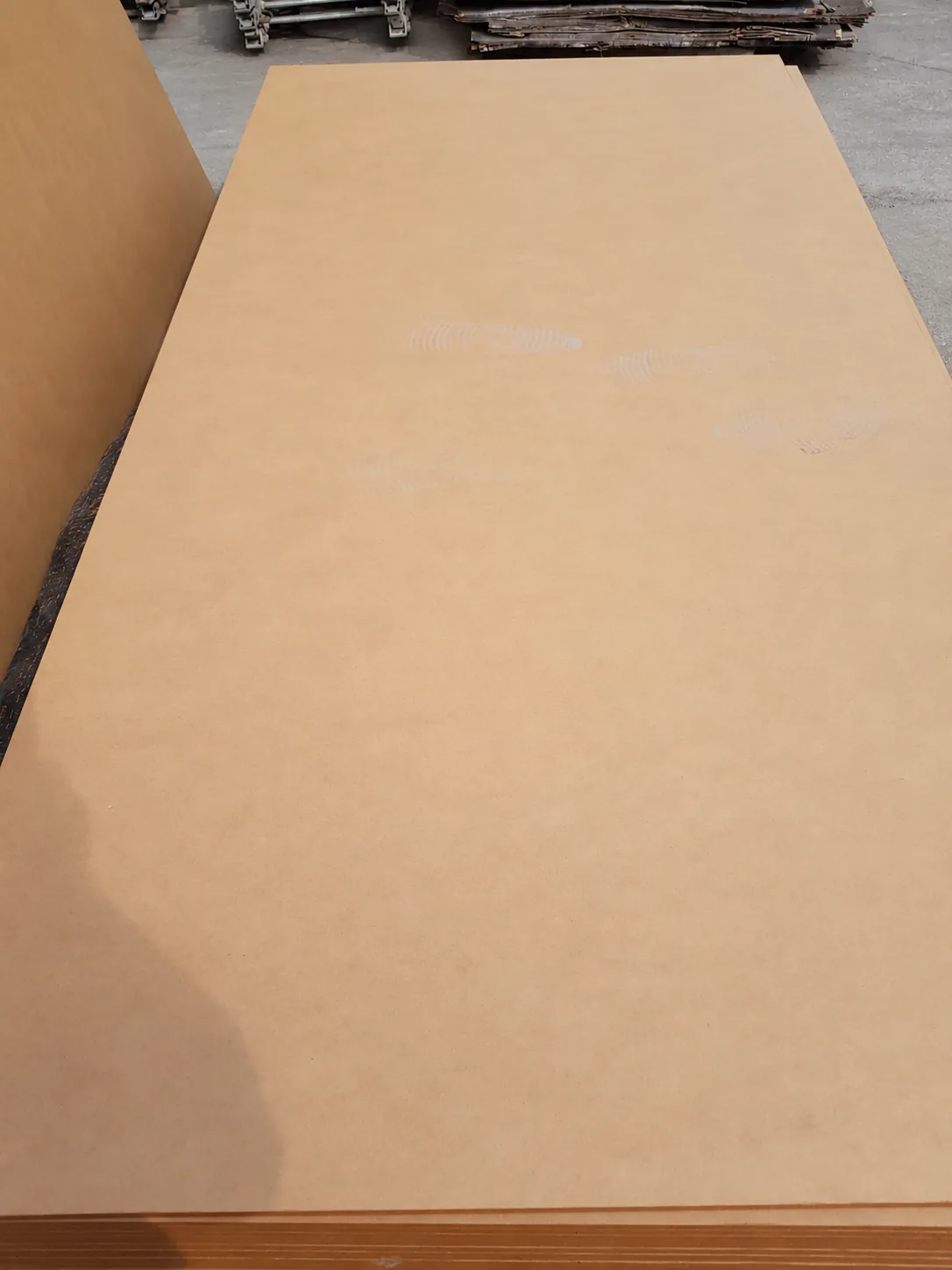
Plain MDF, also called raw or unfaced MDF, gives you a substrate to paint, route or laminate in your own production process.
Build your next furniture range around the part you want to deliver. Choose standard raw MDF in 2.5–35 mm for your thickness and finish brief, then compare the prepared face, machined edge and fitting on a working sample.
Keep board type, thickness and emission option on the same item.
Scroll horizontally to compare all columns.
| Board type | Available options | Continue your purchase |
|---|---|---|
| Standard plain / raw MDF | 2.5–35 mm; E0, E1 or E2. Unfaced board for your dry-interior component and selected machining/finishing process. | |
| Moisture-resistant MDF | 9–25 mm; E0 or E1. Include humid-service conditions, edge/cut-out protection and the selected grade's moisture data. | Explore moisture-resistant MDF |
| Fire-retardant MDF | 9–25 mm; E0 or E1. Specify the fire standard/class required for the board, finish and intended application. | Explore fire-retardant MDF |
Include your destination and required emission test method with the grade. Ask for the proposed item’s corresponding data and shipment documents through the US/EU emission-document guide.
Find the material and finish guide for your component
Understand the substrate behind your finish with the MDF manufacturing process guide. Connect fibre preparation, pressing and sanding with the grade, fit, working sample and quality records needed by your order.
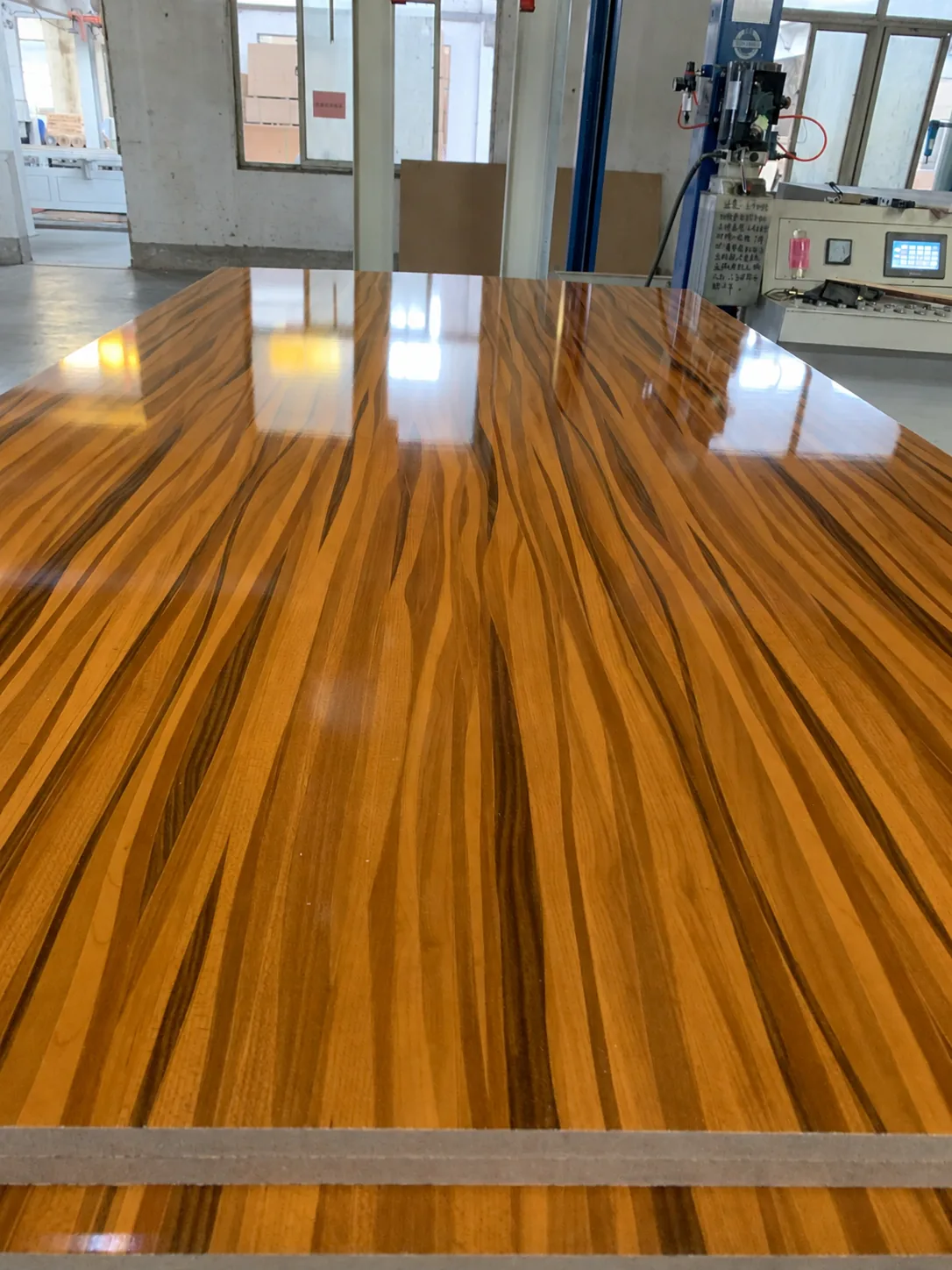
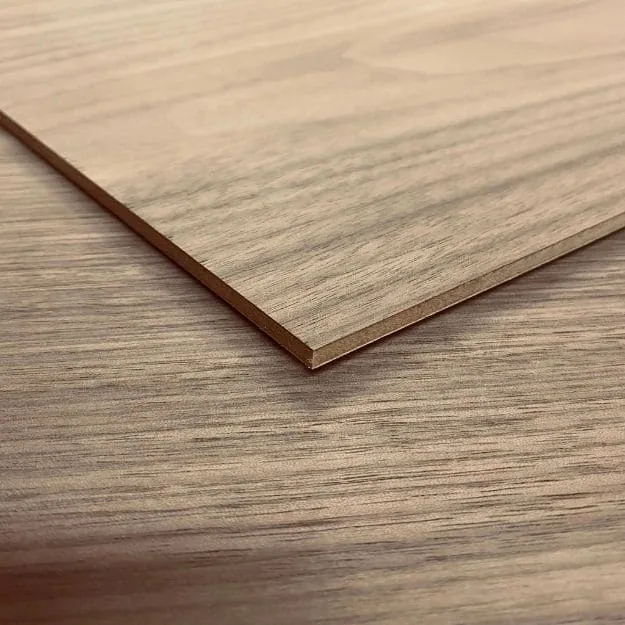
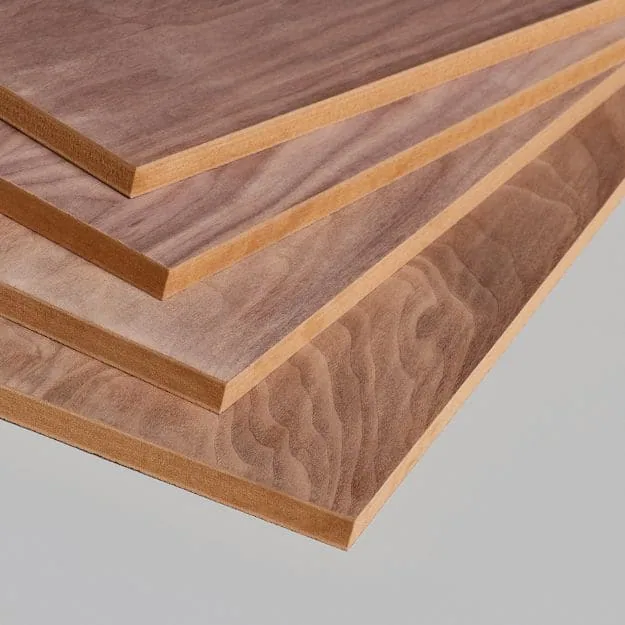
Planning a wood veneer finish? The veneered MDF supply options help you specify the face, MDF core, reverse and complete construction for your quotation. For a slim backing panel or facing base, explore thin MDF options.
Want colour within an exposed edge or routed recess? Compare through-coloured MDF with a painted component. For an outdoor component, use the exterior MDF project brief with exposure, finish and installation.
For a door assembly facing, use the MDF door skin route with the model, delivered dimensions, surface and frame/core trial. For specified HDF or particleboard, use the project material buying routes.
Compare MDF vs HDF, standard MDF versus moisture-resistant MDF, MDF vs melamine board or MDF vs particleboard around the same finished part.
The MDF density and dimensions guide connects board formats, reported data and calculated handling weight.
FROM BOARD TO COMPONENT
What will you make with it?
Painted furniture panels
Cabinet parts, fronts and interior components with a finish applied in your workshop. Include your colour and coating process; compare both the visible face and edges.
Request a painted-part substrate sampleRouted doors & profiles
Doors, decorative fronts and shaped components. Send the deepest profile and hardware details so your trial includes the features that matter in production.
Request a routed-profile substrate sampleLaminate substrates
Furniture and interior components faced after machining. Include the adhesive, facing, back construction and edging in a complete-component trial.
Request a lamination substrate sampleFor shelves and load-bearing furniture parts, share the span, supports and intended load. Use the plywood or MDF guide to compare the design requirements.
Specifications
Supply specifications
Regular sizes mm · width × length
On request
Other sheet sizes and cut-to-size panels on request.
| Nominal thickness | 2.5–35 mmView measured panel data → |
|---|---|
| Board grade | Standard; moisture-resistant (9–25 mm); fire-retardant (9–25 mm) |
| Emission grade | Standard: E0 / E1 / E2; moisture-resistant and fire-retardant: E0 / E1Formaldehyde emission grade. Compare grades, test methods and report values → |
Measured product data
Nanjing Customs District Industrial Products Inspection Center · Interior MDF · 1220 × 2440 × 12 mm
- Measured dimensions
- 2441 × 1221 × 12.08 mm · length × width × thickness EN 324-1
- Density
- 755 kg/m³ EN 323
- Bending strength (MOR)
- 29.8 N/mm² EN 310
- Formaldehyde emission
- 0.038 mg/m³ EN 717-1
EN 622-1 · EN 622-5 · EN 717-1
Details for your application
Panel construction and finishing
| Board | Unfaced MDF for painted, routed and laminated furniture components. |
|---|---|
| Surface | Plain faces prepared for the selected coating or laminating process. |
| Board grade | Choose the substrate for the component and service conditions. Moisture-resistant MDF is available in 9–25 mm; specify its finish and edge protection. |
| Machining | Routing profile, pocket depth, remaining section and fitting details specified from the drawing. |
| Finish | Primer, sealer, topcoat or laminate coordinated with face and routed-edge preparation. |
Specify MDF for the part you manufacture
Send the nominal thickness and finished tolerance you need. For a routed part, include the deepest profile and the material remaining behind it.
| Board grade & environment | State dry-interior use or the exposure expected in service, with any required grade or standard. |
|---|---|
| Thickness & fit | List the nominal thickness, tolerance and dimensions affecting assembly or hardware. |
| Face & finish | Name your paint, primer, sealer or laminate system and the visible finish you want. |
| Machining | Attach a profile or component drawing, including recesses, holes and fitting details. |
| Technical documents | Give the destination, required test methods and any project acceptance limits. |
Compare density alongside a trial of the routed edge, coating and fittings in your finished part.
Choose the board grade for its service conditions
Standard raw MDF is available in 2.5–35 mm with E0, E1 and E2 options. Moisture-resistant MDF is available in 9–25 mm with E0 or E1; Fire-retardant MDF is offered in 9–25 mm with E0 or E1. Include the required emission grade and test method with the thickness and sheet size in your inquiry.
For moisture-resistant board, describe the expected exposure, cut-outs and edge treatment. For fire-retardant board, name the required fire classification, application and test standard, including any finish or facing. Request the documents for the proposed grade and complete construction.
CHOOSE YOUR FINISH ROUTE
Plain, melamine or laminated MDF?
If you need to control the colour, profile or finish yourself, start with plain MDF. If the design calls for a ready-faced surface, compare the finished-board routes before you quote.
FINISH IN YOUR WORKSHOP
Plain MDF
For painted faces, routed doors and components you will laminate. Your inquiry should connect the board to your machining and finishing process.
Compare: face preparation, routed edges and the complete finished part.FLAT DECORATIVE COMPONENTS
Melamine faced MDF
Compare this route for a specified decorative face. Include the decor, texture, back face and edging; machining will expose the substrate.
Explore melamine MDFBONDED DECORATIVE SURFACE
Laminated MDF
Compare the facing material, substrate and back construction as one component. Send your surface reference and intended edge detail.
Explore laminated MDFChoose the thickness around the feature you manufacture.
From a slim furniture back to a routed door, choose a thickness in our 2.5–35 mm standard MDF range. Send the finished dimension and tolerance with the sheet format, tooling, hardware and finish your team uses.
Scroll horizontally to compare all columns.
| Thickness brief | Component to compare | Start with a working sample |
|---|---|---|
| Thin boards · 2.5 / 3 / 6 mm | Furniture back, liner or facing base; frame/groove, fixing, support, handling and finished fit. The thin-board section keeps each route separate. | Request a 6 mm backing-panel sample |
| Furniture fronts · 12 / 18 mm | Painted face and routed profile; deepest recess, remaining material, hinge/connector geometry and complete coating build-up. | Request an 18 mm routed-door sample |
| Thicker parts · 25 / 35 mm | Deep profile or thicker furniture part; machining depth, joints, mass, handling and actual support/load brief. | Request a 25 mm component sample |
For shelves and loaded parts, choose thickness with the span, supports, load and fittings. Include any facing or coating when checking the finished dimensions.
THIN MDF · BUY FOR THE FIT AND FINISH
Thin MDF for the details that bring furniture together.
CUZI supplies standard plain MDF in 2.5–35 mm, including thin-panel requirements for furniture backs, liners and decorative facing bases. Compare a 2.5, 3 or 6 mm specification against your component dimensions, support and finishing process; confirm the selected thickness, tolerance and delivered scope with the quotation.
- 2.5 mm MDF
For slim liners or facing bases, specify the panel dimensions, support and intended surface treatment. Trial cutting, handling and the complete finished part.
- 3 mm MDF
For cabinet and furniture backs, include the frame or groove, visible faces and fitting method. Check the cut-panel dimensions and assembled fit after finishing.
- 6 mm MDF
For thicker backing or decorative components, describe the span, support, joints and loading where relevant. Trial the selected board with its fittings and final finish.
These thin-board routes use standard MDF. Our moisture-resistant and fire-retardant MDF ranges are 9–25 mm; choose the required grade and its documents as a separate material specification. For a curved component, describe the construction and forming trial through Flexible MDF.
What to check on a thin MDF component
- Nominal and measured thickness, agreed tolerance and the material condition used for measurement
- Cut dimensions, frame/groove reference and assembly stage, including any face or coating build-up
- Edge condition, fastener or adhesive arrangement, support and loaded-part requirements
- Finished face, reverse, flatness and fit after the intended preparation and finishing process
- Sample/item code, quantities, pack protection and receiving checks for the repeat order
Keep the sample with the drawing and the proposed board data. Request technical information for the selected thickness.
Sheet formats, cut parts and packing for thin boards
Regular MDF formats are 1220 × 2440 and 2100 × 2800 mm; 1220 × 3050, 1830 × 3660 and 1220 × 3660 mm are on request. Identify sheet formats and finished-part dimensions separately, then confirm the thickness/format combination and cutting scope with your quotation.
Specify even bundle support, face/corner protection, cover-board needs, pack quantities and item labels. Discuss handling and unloading requirements, keep different thicknesses identifiable and check dimensions and condition before processing.
Use the cut-to-size panel route for your part list and the incoming-panel checklist for receiving observations.
EXTERIOR MDF · BUY FOR THE EXPOSURE
Bring your outdoor design into a clear material brief.
CUZI supplies exterior MDF for project orders. Share the component, location and expected exposure, then specify the proposed board designation, dimensions, finishing system and installation detail together. Exterior-board thickness, formats and performance documents are confirmed for that item.
- Indoor humidity
- For kitchen, bathroom or other humid-interior furniture, review our 9–25 mm MR MDF range. Keep the actual grade, face/edge finish and service conditions with the component specification.
- Sheltered outdoors
- Describe the canopy or shelter, condensation, splash, drainage and exposed joints. Ask for the proposed material’s documented use conditions and a suitable complete finishing system.
- Weather exposure
- Give the expected rain/wetting, sunlight, temperature conditions and maintenance access. Connect the exterior-grade panel with protected faces, reverse, cut edges, fixing holes and the installed detail.
For outdoor use, choose an exterior grade and a finish and edge-protection system suited to the exposure. Follow the panel and coating suppliers’ installation guidance.
Searching for waterproof MDF? Explore MR / HMR options.
For kitchen, bathroom and humid-interior furniture, start with MR / HMR MDF. Share your thickness, finish and expected moisture exposure so we can propose the board and sample for your component.
For outdoor use or repeated wetting, include the location, drainage, edge protection and finish in your exterior MDF inquiry. We’ll discuss the proposed grade and relevant technical data with your quotation.
Materials, finish and documents to compare
- Exterior-board identity, thickness, density/dimension data and required emission method for the offered item
- Relevant moisture, dimensional stability or durability test results, including method and reported conditions
- Allowed service exposure and any limitations, with the intended location and installation section
- Complete face, reverse, edge and cut-out treatment, coating compatibility and maintenance information
- Representative finished sample, drawing revision, fixing/assembly checks and receiving/packing requirements
Keep the grade data and coating instructions with the accepted sample. Match any indoor MDF report to its stated material and use.
For general material selection and finishing context, see the European Panel Federation guidance on MDF outside and discuss the actual grade and coating system with the proposed suppliers.
COMPARE OPTIONS
Your selection at a glance
Core requirements
Specify board grade and density requirements alongside the final application.
Surface and edges
Describe routing, sanding, primer and coating. Edge quality and surface preparation affect the finished result.
Environment
Include moisture exposure and emission requirements in the written specification, with the requested test method.
MDF MATERIAL & EMISSION TEST DATA
Put the material data behind your MDF choice.
Review the RAW MDF physical and mechanical results alongside the SGS 18 mm MDF formaldehyde report. Use the material data, your component drawing and the selected emission option to build one complete supply specification.
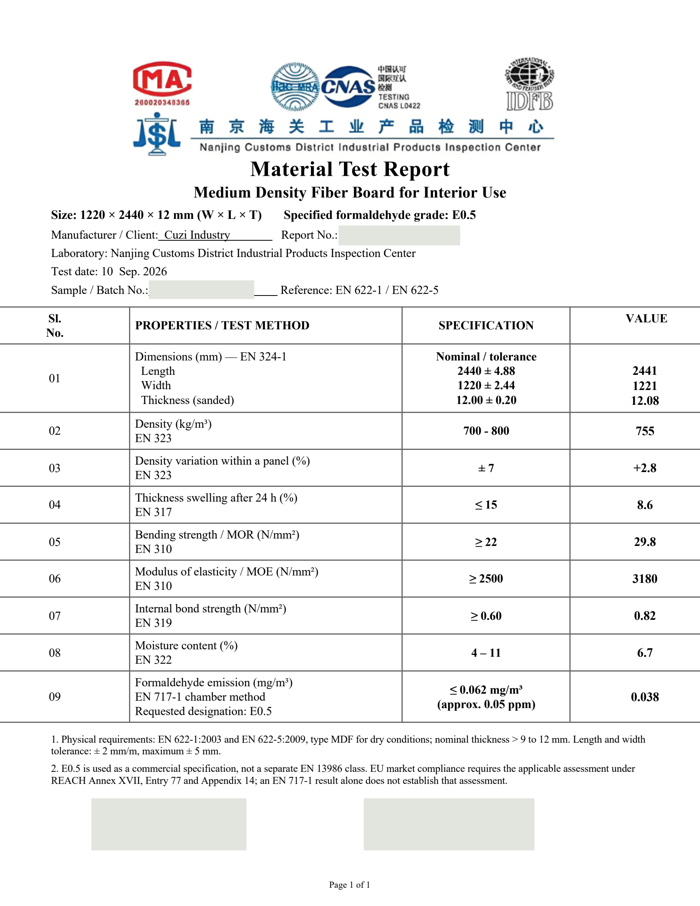
RAW MDF Test Report
Interior MDF for dry conditions · nominal 1220 × 2440 × 12 mmReport reference: EN 622-1:2003 / EN 622-5:2009- Density
- 755 kg/m³ EN 323
- Bending strength (MOR)
- 29.8 N/mm² EN 310
- Formaldehyde emission
- 0.038 mg/m³ EN 717-1
View all test results
| Property | Method | Result |
|---|---|---|
| Measured dimensions | EN 324-1 | 2441 × 1221 × 12.08 mm · length × width × thickness |
| Density | EN 323 | 755 kg/m³ |
| Density variation within a panel | EN 323 | +2.8 % |
| Thickness swelling after 24 h | EN 317 | 8.6 % |
| Bending strength (MOR) | EN 310 | 29.8 N/mm² |
| Modulus of elasticity (MOE) | EN 310 | 3180 N/mm² |
| Internal bond strength | EN 319 | 0.82 N/mm² |
| Moisture content | EN 322 | 6.7 % |
| Formaldehyde emission | EN 717-1 | 0.038 mg/m³ |
SGS · 18 mm MDF formaldehyde emission
18 mm MDF · White-colour board · EN 717-1:2004- Formaldehyde emission
- 0.080 mg/m³ SGS · Reported result
- Board thickness
- 18 mm Report description
- SGS conclusion
- PASS Formaldehyde emission
View the 18 mm MDF result, method & E1 reference
| Product | 18 mm MDF · CUZI |
|---|---|
| Material description | White-colour MDF |
| Reported result | 0.080 mg/m³ |
| Method reference | EN 717-1:2004 |
| Analysis | UV-Vis |
| E1 reference | EN 13986:2004(E) · ≤ 0.124 mg/m³ |
| Conclusion | PASS |
Keep the method, unit and board description attached when comparing emission data. Choose E0, E1 or E2 for your order and include the corresponding destination requirements with the selected thickness and finished construction.
Product test reports & records
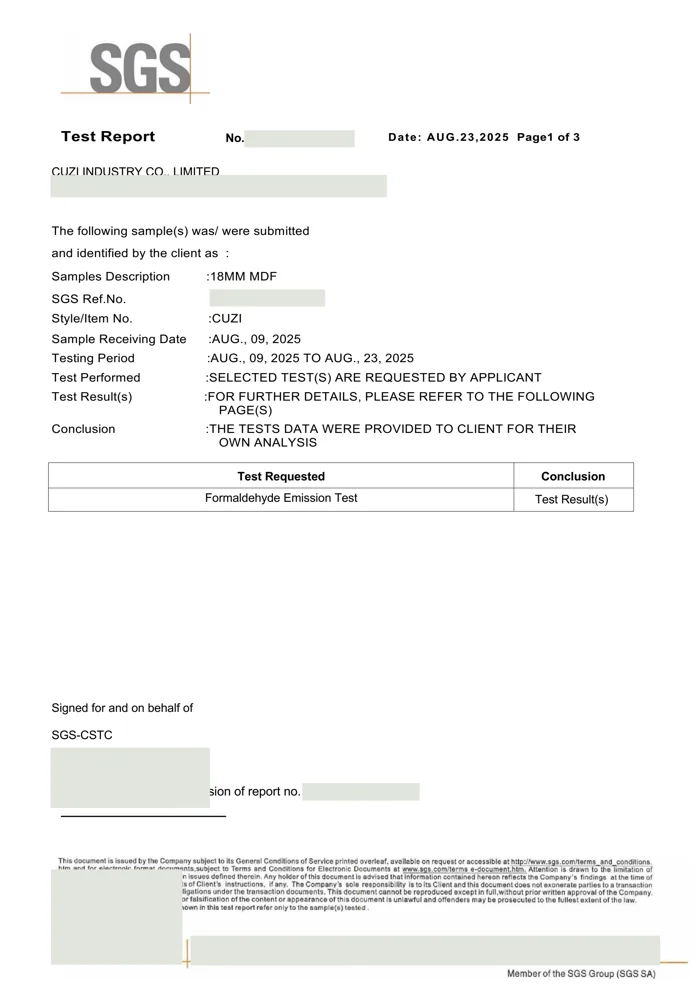
18 mm MDF Formaldehyde Test Report
18 mm MDF
SGS formaldehyde emission test results for 18 mm MDF, with the test method and material description.
EN 717-1:2004
3 pages · 1.1 MB- Connect the data to your process
- Use density, internal bond and dimensional data alongside your routed profile, hardware pockets and preparation process. Trial the most demanding detail with the coating or laminate you intend to use.
- Specify the finished component
- For a shelf or supported part, send the span, supports, working load and finished dimensions with the bending-property requirements. For faced MDF, include the facing, reverse and edge detail in the technical request.
- Build the destination file
- Select E0, E1 or E2 with its requested method and market documents. Keep each thickness, format and quantity identifiable, together with the selected board, sample and report references for repeat orders.
Preparing a US or EU order? Use our MDF and plywood emission-document guide to connect the report, offered board and destination requirements.
Request the technical package for your order item.
Send your board grade, thickness, destination and application with the data request. Include the finished-component drawing and the machining or facing work required in the supplied scope.
Product data & reports to request
Request a technical data sheet covering:MDF grade, nominal thickness, formats, density or application data, required emission option and test method for the offered item.Include these specification details:- Substrate grade and intended service environment
- Nominal thickness, dimensions and requested tolerance
- Emission test method and destination or project documentation
Company documents to view
FSC chain of custody Wood panels · purchase & salesISO 9001 & ISO 14001 Management systems · stated sales activitiesView our company certificates alongside the technical data for your selected panel.Plain MDF material, component and service requirements: what to match
- Proposed material
- MDF grade, nominal thickness, formats, density or application data, required emission option and test method for the offered item.
- Dimensions and finished fit
- Required tolerance, measurement conditions, cut-part dimensions, frame/groove, support and face/back or coating build-up.
- Trial and delivery
- Retained sample and drawing, machined/finished appearance, assembled checks, quantities, pack protection and receiving labels.
- Exterior project specification
- Proposed exterior-board designation, exposure/service conditions, relevant test data, face/reverse/cut-edge protection, installation and maintenance information for the offered item.
US & EU document checklistProduct + destination
Your panel specification. Standard raw MDF: selected grade, nominal thickness, format and producer.
Thickness: 2.5–35 mm.
US
MDF or thin MDF category, matched to the selected thickness and producer.
Request US documentsEU
Unfaced board and intended article, with the selected grade and machining or finishing route.
Request EU documentsKeep density and mechanical data with the grade and dimensions. The published RAW MDF report identifies nominal 1220 × 2440 × 12 mm interior board.
BEFORE YOU ORDER
Ordering information
- Minimum order
- 1 container
- Regular lead time
- 10–15 days
- Samples
- Free samples
- Quotation terms
- FOB / CIF
Sample freight & order notes
- Minimum order: Mixed loads available.
- Regular lead time: Production; shipping time is additional.
- Samples: Buyer pays freight; full credit on a formal order.
- Quotation terms: Name the port in your inquiry.
TRY IT IN YOUR PRODUCTION
Start with a sample. Test your finish.
Send the MDF specification and component you want to evaluate. Samples are free; you pay the freight. Sample freight is credited in full against your formal order.
- Share the partTell us the thickness, finish and sample dimensions. Attach a profile drawing if routing or hardware fit is central to your decision.
- Make the componentCondition the board and use your production tooling. Apply the intended face and edge preparation, coating or laminate.
- Keep the referenceCheck appearance, fit and flatness after the finishing process. Keep the sample, drawing and process record together for the order.
Requesting a thin board? Include the selected thickness, sample dimensions and frame, groove or facing detail. Evaluate the part at the same finished stage used in the drawing.
Machining and finishing notes for your trial
Use consistent tooling and settings when comparing boards. Inspect the machined profile before coating, then record preparation and the finished result separately for faces, edges and recesses. Confirm sealer and coating compatibility with your finish supplier. Follow your equipment’s operating procedures and use appropriate dust extraction.
Read the European Panel Federation guidance on finishing MDF edges and the Composite Panel Association technical resources for handling and fabrication references.
PACKING & DELIVERY
Plan for the receiving workshop.
Specify pack weight and handling limits, unloading equipment and item labels with your inquiry. Request edge and corner protection, even support and covered transport for the proposed shipment.
Keep grades, thicknesses and item references identifiable when the boards arrive. Check quantities and pack condition before cutting or finishing, and record any transit damage with its bundle reference.
For a FOB quotation, agree the port of shipment; for CIF, name the destination port. Include your destination and receiving requirements with the schedule you want quoted.
BUILD YOUR NEXT CONTAINER
Buy around your production schedule.
Start with one container and combine product lines in a mixed load. List quantities separately for each size, thickness and finish so the quotation follows your item schedule.
Regular production takes 10–15 days; sea freight and destination handling are additional. Send your target receiving date and port so the proposed schedule covers both production and delivery.
For a repeat range, keep the accepted sample and specification tied to each item. Explore wholesale MDF ordering for your purchasing program, or include laminated MDF where your range needs a faced component.
Make the MDF board price comparable.
Scroll horizontally to compare all columns.
| Compare | Keep equal between offers | Record with the price |
|---|---|---|
| Material and quantity | Board grade, nominal/finished thickness, format, density/property brief and emission option with its method. | Sheets or m³ by item, price unit, proposed model, sample and document references. |
| Delivered processing | Full sheets versus cut/routed/drilled parts, sanding/preparation and any supplied facing, coating or edges. | Your own cutting yield, preparation/coating time, finishing consumables and rework for the same accepted component. |
| Commercial and shipment scope | Order mix, pack protection and quantities, named FOB/CIF port, production schedule and quote validity. | What the offer includes, shipping/receiving scope, payment terms and delivery plan for that order. |
Send thickness, sheet size, quantity and port to get a price for your item. For an established range, include the existing specification and any drawing changes so the repeat offer follows the same component.
MAKE THE INQUIRY SPECIFIC
A painted cabinet door buying brief.
For a routed cabinet door, a sheet-price comparison is only the start. Connect the board quotation to the profile, finish and fitting that the customer will receive.
Plan the panel weight before the pack weight.
The RAW MDF report gives a density of 755 kg/m³ for the reported interior board. Using its nominal 1220 × 2440 × 12 mm dimensions gives the calculation below.
Scroll horizontally to compare all columns.
| Quantity | Calculation / value | Use in the order |
|---|---|---|
| Net panel volume | 1.220 × 2.440 × 0.012 = 0.0357216 m³ | Nominal sheet dimensions; list other thicknesses and formats as separate items. |
| Calculated net panel mass | 0.0357216 × 755 = 26.97 kg per nominal sheet, rounded | A calculated handling reference. Actual net mass follows the item's density, measured dimensions and material condition. |
| Packed shipment weight | Measured panel/bundle mass plus the identified packing tare | Sheets per bundle, gross bundle weights, dimensions and unloading limits. Keep the loading plan with the actual item mix. |
For another board or thickness, use its stated density and dimensions. Request density variation or profile data where routing is critical; the full machining and finishing trial remains part of the comparison.
If component mass is part of the brief, compare Lightweight MDF using the same dimensions, intended finish and hardware. Include the density or weight target with the material data and complete-part trial.
Working on a curved component? Discuss the flexible MDF project requirements with the section, radius reference, bend direction and final facing. The forming construction and sample are considered separately from ordinary sheet supply.
Want processing before delivery? Use the MDF machining service with your profile section, hole or groove positions and requested finishing scope. Included operations and part tolerances are confirmed against the drawing.
- Component
- Door dimensions, thickness tolerance and profile drawing with its revision.
- Finish
- Face and edge preparation, sealer, primer and topcoat used in the trial.
- Fit & appearance
- Hardware pockets, assembly fit, routed-edge appearance and flatness after curing.
- Order schedule
- Sheets by thickness and size, destination port, FOB or CIF and target receiving date.
Use the most demanding profile as the trial reference. Compare preparation time and rework as well as appearance, then link the selected sample to the specification in your order.
Sample checklist
Compare samples on the same basis.
Use this worksheet to keep the material, process and finished result connected. Add your acceptance limits and observations before you choose the board for production.
| Check | Record during evaluation |
|---|---|
| Board reference & grade | Sample code, offered grade, intended environment and matching technical documents. |
| Dimensions & fit | Actual thickness, finished dimensions, tolerance and fit against the component drawing. |
| Exterior grade and exposure | Proposed board designation, exposure/service conditions, relevant test data, complete face/reverse/edge treatment, installation detail and maintenance requirements. |
| Thin-panel fit and support | Selected nominal thickness, measured condition, frame/groove reference, support, face/back build-up and assembled fit after finishing. |
| Machined profile | Profile revision, remaining material, tooling setup and edge or recess condition before finishing. |
| Face & edge finish | Preparation, coating or laminate system, appearance and corrective work by feature. |
| Hardware & assembly | Fitting reference, holes or recesses, assembly fit and condition after the finishing process. |
| Production decision | Accepted sample and process, outstanding changes, approval responsibility and order item reference. |
If the trial needs another pass
The routed edge differs from the painted face
Inspect the profile before coating and compare preparation and sealer application. Review compatibility with the finish supplier, then repeat the same profile and coating process.
The hardware recess fits inconsistently
Measure the panel and recess against the fitting. Separate a board thickness requirement from a machining adjustment, then check the complete assembly after the change.
For wider fabrication topics, see the CPA technical resources.
FAQ
Plain MDF buying questions.
Are plain MDF and raw MDF the same product type?
Both terms describe unfaced MDF before paint or a decorative facing is applied. Specify the actual grade, thickness and finish route in your inquiry rather than relying on the name alone.
Which sheet sizes can I request?
Regular MDF formats are 1220 × 2440 and 2100 × 2800 mm. Formats of 1220 × 3050, 1830 × 3660 and 1220 × 3660 mm are available on request, along with other sizes and cut-to-size panels. List the thickness and quantity for each size.
For component dimensions, send a cut-to-size MDF inquiry with part codes, finished sizes, quantities and any requested edge or machining work. Confirm the delivered processing scope with the quotation.
Which thicknesses, board types and emission options are available?
Standard raw MDF is available in 2.5–35 mm with E0, E1 and E2 emission options. Moisture-resistant MDF is available in 9–25 mm with E0 or E1; fire-retardant MDF is also available in 9–25 mm with E0 or E1. Specify the grade, thickness and size together, with your destination and required test method.
Which technical information can I review?
The RAW MDF report lists dimensions, density, swelling, bending properties, internal bond, moisture and formaldehyde emission, with the test methods used. Include the grade, thickness, destination and required standard when requesting the documents for your order.
Can I view an SGS formaldehyde report for 18 mm MDF?
Yes. The SGS 18 mm MDF report records 0.080 mg/m³, references EN 717-1:2004 and includes a PASS conclusion. The complete three-page document includes the white-colour board description and photograph.
How do I compare the RAW MDF and 18 mm MDF reports?
Keep each report with the material and thickness it identifies. The RAW MDF report covers nine physical, mechanical and emission properties for interior board at nominal 1220 × 2440 × 12 mm. The SGS report records formaldehyde results for 18 mm MDF. Use the method, unit, construction and destination requirements together when requesting data for your selected order item.
How is the price of raw MDF quoted?
Use the same board type, thickness, size, property/emission brief and quantities, with the supplied processing and named FOB/CIF port. The quotation comparison connects sheet price with your preparation, yield and finished-component cost.
How much does an MDF sheet weigh?
Calculate net mass as volume in m³ × density in kg/m³. The RAW MDF density calculation uses the report's nominal board dimensions; use the offered item's values for other constructions and separate panel net mass from gross packed weight.
Can I request a particular density for routed furniture?
Send the part, deepest profile, fittings and desired density or mass target. Compare the proposed model's density/profile and machining data together with a finished-part trial. Use Lightweight MDF when the component has a different density/weight brief.
Does CUZI supply exterior MDF?
Yes, for project orders. Send your component, dimensions and exposure brief. The proposed exterior-board designation, thickness, format, finishing requirements and documents are confirmed with the quotation.
Is moisture-resistant MDF the same specification as exterior MDF?
Choose MR MDF for humid interiors. For outdoor use, discuss an exterior grade with the right finish, edge protection and installation detail for the exposure.
What should I ask for when searching for waterproof MDF?
Start with MR / HMR MDF for humid-interior furniture. Tell us the application, thickness, finish and expected moisture exposure. For outdoor or repeatedly wet conditions, share the complete component and installation detail so we can discuss an exterior grade and the relevant product data.
Do the standard MDF thicknesses and RAW report define the exterior board?
The standard MDF range and interior RAW report retain their stated scope. Exterior grade, thickness, formats and required data are confirmed separately for the proposed outdoor component.
Does CUZI supply thin MDF?
Yes. Standard plain MDF is available in 2.5–35 mm. Send the nominal thickness, size, quantity, finish and application for your thin-panel quotation and sample; 2.5, 3 and 6 mm buying routes are provided on this page.
Which thickness should I choose for a furniture back?
Use the drawing, panel dimensions, frame or groove, fitting arrangement and finish as the starting point. Compare the selected thickness in the actual supported assembly and record its fit and relevant loading conditions.
Can I use the thin-board range for moisture-resistant or fire-retardant MDF?
Our confirmed moisture-resistant and fire-retardant MDF ranges are 9–25 mm. Keep the grade and thickness together when selecting the board; request the required technical and destination documents for that specific item.
Is thin MDF automatically a flexible forming board?
A curve needs its own construction, bend direction, radius reference and trial. Use the Flexible MDF page to define the proposed forming panel and complete curved part.
Can a finished face save painting work?
Melamine faced MDF is worth comparing for flat decorative components. For a painted routed design, include the profile and the treatment of exposed machined areas in the sample trial.
Can I request a sample before a container order?
Yes. Share the board specification, sample dimensions and delivery details. Samples are free and the buyer pays freight. Sample freight is credited in full against your formal order.
Can I mix MDF with other panels in one container?
Mixed loads are available with a minimum order of one container. Send quantities by product, size, thickness and finish; container type and loading quantities are agreed for the item schedule.
What should I send for a FOB or CIF quotation?
Send the application, dimensions, thickness, quantities and document requirements. Name the port of shipment for FOB or the destination port for CIF, with your target receiving date.
Should I use MDF for a long shelf?
Compare the span, thickness, supports and sustained load for the complete shelf. The plywood and MDF selection guide helps frame those design questions; test the actual assembly rather than choosing by surface appearance.
What should I confirm for painted MDF doors?
Provide the door dimensions, profile, thickness tolerance and coating process. Trial both routed edges and faces on a sample, because they may require different preparation.
Which guides can help me choose this panel?
For this product, read How MDF Is Made: The Quality Questions Behind a Furniture Order or MDF vs HDF: Match the Board to Your Component. Use the panel comparison to compare your shortlist before requesting samples or a quotation.
LET’S QUOTE YOUR MDF
Send the part. We’ll start with the board.
A drawing, finish reference or simple item list is enough to start. Add the details you have; use this outline if you want to make quotations easier to compare.
Open the Plain MDF inquiry outline
I would like a quotation for Plain MDF.

Application / destination:
Thickness / sheet or finished part size:
MDF grade / emission requirement:
Density or weight target, if needed:
Routing / fittings / paint or facing:
Quantity / mixed-load items / spares:
Samples or product documents needed:
Packing / FOB or CIF port / required date:
Download the Plain MDF inquiry outline (.txt)