FROM THE BOAT DRAWING TO THE PANEL ORDER
Start with the part you want to build.
Bring the construction, finish and purchasing plan together.
A cabin fit-out, a replacement locker and a designer-specified boat component each start with a different brief. Tell CUZI where the plywood will go, what your workshop needs to do with it and the product requirements on your drawing. We can discuss the proposed panel and prepare a quotation around that part.
Carry the face, internal veneers, thickness and bond description into the same order item. It gives your buyer, fabricator and receiving team a clear reference from the first sample through to repeat purchases.
Choose around the finished component.
Scroll horizontally to compare all columns.
| Your component | Start the comparison with | The production decision | Keep on the order line |
|---|---|---|---|
| Cabin cabinets, lockers and fitted joinery | An Okoume-faced panel or an all-Okoume construction with the required marine designation. | Compare the completed part’s weight, cut-edge finish, connector fit and coating process using the same drawing. | Face/back, internal species, layer schedule, measured thickness and the retained component sample. |
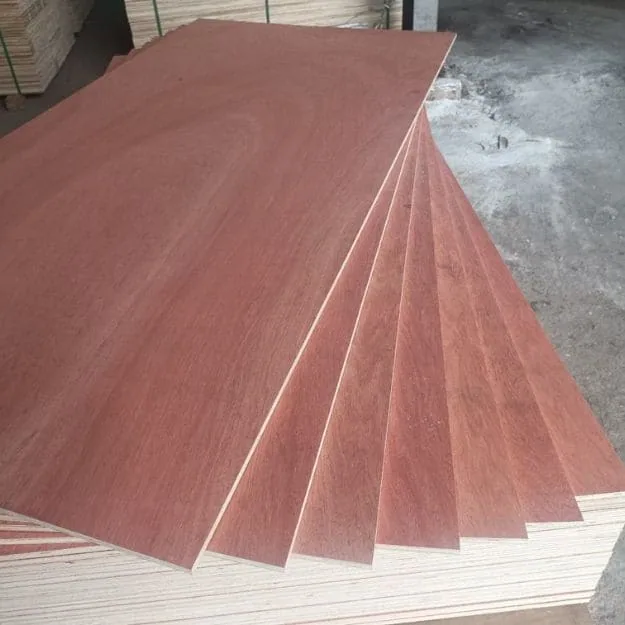
| Visible doors, partitions and decorative fit-outs | The Sapele face or another specified decorative construction over the required marine panel. | Compare adjoining faces under the intended finish and lighting. Price veneer matching, panel sequence and reverse treatment with the set. | Veneer reference, matching arrangement, front/reverse, complete finished thickness and coating scope. |
| Replacement parts and repeat stock | The original item, drawing and marine designation, plus the current installation detail. | Check finished dimensions, joints and openings against the part being replaced. Quote changed materials or dimensions as separate alternatives. | Item and drawing revision, accepted changes, part quantities, grain direction and pack labels. |
| A hull-related or load-bearing part | The designer’s marine-panel designation and the additional structural requirements for the component. | Have the proposed construction and relevant data reviewed against loads, supports, joints and installation before the material choice is finalized. | Specified grade and edition, identified model/data, drawing revision and the agreed construction. |
In a fit-out quotation, compare panel purchase, usable cutting yield, machining, coating and hardware preparation for the same finished output. A construction that suits your finish or removes a processing step can be worth more than a lower sheet price. Use the completed-part cost guide to build that comparison.
Choose the face and the inner construction together.
Scroll horizontally to compare all columns.
| Construction brief | Identify on the offer | Compare a working sample |
|---|---|---|
| Okoume face with specified inner veneers | Okoume face/back requirements plus the named internal species, veneer gauges, lay-up and permitted defects. Keep the marine product and bond designation with that complete construction. | Face appearance, prepared cut section and your edge, joint or opening detail. |
| All-Okoume construction | Okoume specified through face, back and internal veneers; layer schedule, finished thickness and required marine designation identified for the proposed model. | Both surfaces and a section with its model identity. Include forming, machining or weight requirements for your part. |
| Sapele decorative face | Visible Sapele veneer, back arrangement, internal marine construction and intended coating. Species and appearance remain separate fields from the required product standard. | Colour/grain range and the completed face, edge and reverse beside your fit-out reference. |
Ask for the offered model's veneer schedule and measured panel data. A species name or a cut-edge photograph gives only part of the construction information.
Explore Okoume construction options when species is part of your brief, or the Sapele veneer guide for a decorative face. Include the required marine construction alongside your surface choice.
Specify the face and the internal veneers
A face species describes the visible veneer; an all-species construction describes the internal layers too. Ask the quotation to identify both, together with lay-up and permitted internal defects. Use a cut-edge sample to review the construction being proposed.
For exterior joinery or an outdoor component, explore Exterior Grade Plywood with the intended exposure, required panel grade and complete finishing detail. Keep a specified marine construction with its own boat-component requirements.
For a freight-container floor purchase, explore Container Flooring Plywood with its floor drawing and material/repair specification. Keep the container-floor construction and fitting requirements identifiable in the inquiry.
Comparing the project’s marine requirement with an exterior offer? Read our marine versus exterior plywood guide to align the veneer construction, bond and product documents.
Keep the required bond assessment with the complete marine construction. Our plywood bonding guide explains the EN requirements, methods and product-document fields to include beside the drawing.
MAKE THE MATERIAL FIT THE COMPONENT
Cabin joinery, coated parts and replacement panels.
Cabin & locker joinery
Bring the visible face, hidden back and hardware positions into the panel brief. Try your finish on a sample before settling the material for the fit-out.
Request a locker joinery sampleCoated boat components
Work from the component drawing and required panel construction. Include cut edges, joints and service openings in the coating and fabrication plan.
Request a coated-detail trial sampleRepair & replacement parts
Identify the existing part and the builder's material requirement. Quote the needed sizes and quantities against that description to prepare the replacement work.
Request a replacement-panel sampleFor machining and coating details, use the marine component coating and penetration brief. Include the designer's specified grade and product data for hull-related or load-bearing parts.
Specifications
Supply specifications
Regular sizes mm · width × length
On request
Other sheet sizes and cut-to-size panels on request.
| Thickness | Nominal thickness to your specification; finished thickness and tolerance quoted with the panel construction.View measured panel data → |
|---|---|
| Panel | Plywood quoted for boat joinery, marine components and replacement work against your material brief. |
| Veneer construction | Face/back species, internal veneers, lay-up and required internal quality identified in the panel quotation. |
| Thickness & finish | Share the finished thickness and tolerance, surface grade, sanding and intended coating or decorative finish. |
| Product requirement | Required marine standard, edition, bond and product documents included with the offered item. |
| Order plan | Sheet formats or cut sizes, quantities, sample reference, pack labels and FOB/CIF port. |
Measured product data
SGS · Marine plywood · 1220 × 2440 × 18 mm
- Bonding quality
- Class 3 BS EN 314-1:2004
- Density
- 599 kg/m³ EN 323:1993
- Moisture content
- 11.1% BS EN 322:1993
BS 1088-1:2003 · EN 314 · EN 323 · EN 322
Details for your application
Your marine plywood supply brief.
Choose a sheet format, then share the thickness and construction your project calls for. The quotation will identify the proposed face, core, bond and product documents for that item.
Want to review the panel data first? See the SGS results for 18 mm, 11-ply marine plywood, including bonding quality, density, moisture content and dimensional measurements.
| Component & drawing | Part name, installation position, drawing revision and the required material designation. |
|---|---|
| Thickness & construction | Finished thickness, tolerance, veneer species, lay-up and internal quality requirements. |
| Face & finish | Visible and hidden faces, veneer grade, sanding and coating or decorative finish. |
| Marine requirement | Product standard and edition, bond requirement and documents specified for the component. |
| Sizes & processing | Sheet or cut dimensions, grain direction, forming, machining and quantities by part. |
| Shipment | Pack protection, item labels, destination port and your planned receiving date. |
Compare the product designation as well as the bond
Marine product specifications address the panel construction as well as bonding. Put your project's complete designation in the inquiry. APA's plywood guidance explains its product and bond classifications; use the classification and product documents required for your own project.
THREE WAYS TO START YOUR PURCHASE
A fit-out, a specified component or your next stock order.
Choose the route closest to your work. You can begin with a drawing, a surface reference or a list of panel sizes.
Develop boat joinery
Compare the face, cut edge and finish in your workshop. Connect the proposed construction with the hardware and coating process your team uses.
Plan your component sampleBuy to the boat drawing
Send the material designation and required documents with the drawing revision. Compare prices for the same construction, sizes and shipment.
Prepare the drawing briefPlan stock & replacements
List the constructions and dimensions your customers need. Keep each item identifiable for warehouse picking and future replenishment.
Build the stock scheduleKeep inch references and the offered millimetre size visible.
Our regular sheet formats are 1220 × 2440, 1250 × 2500 and 1525 × 3050 mm. Request 1220 × 3050, 1250 × 3660 mm or a cut-part format for your layout. A 4 × 8 ft drawing equals 1219.2 × 2438.4 mm; state whether the drawing requires that exact dimension or accepts the offered metric sheet and trimming allowance.
Scroll horizontally to compare all columns.
| Drawing reference | Exact conversion | Take into the inquiry |
|---|---|---|
| 1/4 inch | 6.35 mm | Required finished thickness and tolerance, joint/groove fit and the proposed metric construction. |
| 1/2 inch | 12.7 mm | Part duty, facing/core and bond designation alongside the measured thickness and hardware detail. |
| 3/4 inch | 19.05 mm | 19.05 mm on the drawing and the supplier's stated nominal/finished dimensions; compare tolerance and fit when considering an 18 mm offer. |
These conversions describe the drawing requirement. The quotation identifies the thickness available for the selected marine model, its finished tolerance and any accepted dimensional alternative.
COMPARE OPTIONS
Your selection at a glance
Component & finish
Choose the face and internal construction against the drawing. Try machining, joints and your intended coating on a representative sample.
Material & documents
Include the required product designation, standard and corresponding panel data. Keep the species, lay-up, thickness and sample identity with the offer.
Price & repeat orders
Compare the same construction, part dimensions, processing and FOB/CIF scope. Retain the selected item and drawing reference for replacement or repeat supply.
MARINE PLYWOOD TEST RESULTS
See the data. Plan the right panel order.
Review the SGS report for 1220 × 2440 × 18 mm marine plywood with 11 plies. Compare the bonding quality, density and moisture content, then bring your component drawing and material requirements into the quotation.
- Bonding quality
- Class 3 BS EN 314-1:2004
- Density
- 599 kg/m³ EN 323:1993
- Moisture content
- 11.1% BS EN 322:1993
Product test reports & records
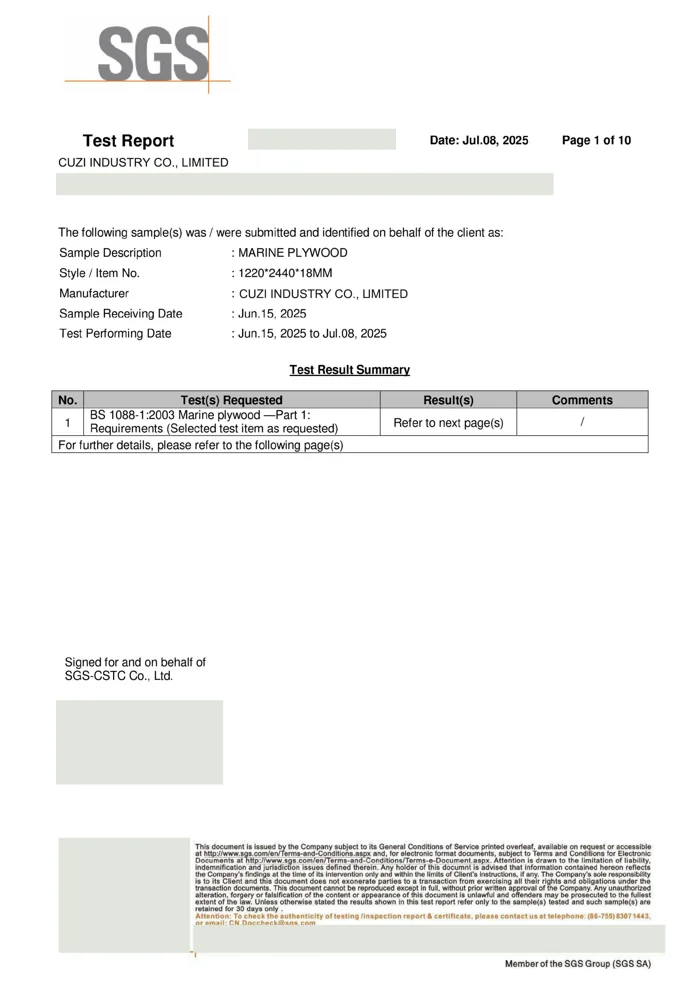
Marine Plywood Test Report
Marine plywood · 1220 × 2440 × 18 mm
SGS test results for 18 mm marine plywood, covering dimensions, appearance, bonding quality, density and moisture content.
BS 1088-1:2003 · EN 314 · EN 323 · EN 322
10 pages · 7.9 MBView dimensions, appearance & bonding results
Scroll horizontally to compare all columns.
| Property | Report result | Test method |
|---|---|---|
| Bonding quality | Class 3 | BS EN 314-1:2004 |
| Glue-line shear strength | #1: 1.02 · #2: 1.18 · #3: 1.27 N/mm² | BS EN 314-1:2004 |
| Density | 599 kg/m³ | EN 323:1993 |
| Moisture content | 11.1% | BS EN 322:1993 |
| Mean thickness | 17.95 mm | BS EN 324-1:1993 |
| Length × width | 2441 × 1221 mm | BS EN 324-1:1993 |
| Squareness | 0.5 mm/m · Pass | BS EN 324-2:1993 |
| Edge straightness | 0.3 mm · Pass | BS EN 324-2:1993 |
| Surface appearance | Pass | Visual inspection |
| Manufacturing defects | Pass | Visual inspection |
The report covers BS 1088-1:2003 clauses 5.1, 5.2, 5.3, 5.4, 5.6 and 5.7. Pages 2–9 contain the result summary, measurements and assessment details; the PDF also includes panel and glue-line photographs.
- Specify the bond and construction
- Keep the Class 3 result alongside your required marine designation, veneer construction and any structural requirements on the boat drawing.
- Compare the panel weight
- Use the density with your panel dimensions and cutting list. Include the density you need when requesting another thickness or veneer construction.
- Plan machining and finishing
- Carry the moisture reading into the workshop brief with your coating, edge and hardware details. Follow the finishing system’s preparation and conditioning instructions.
Buying to a boat-builder or designer specification? Include its required standard, edition and destination with your inquiry. Use the routes below to request the construction and product documents for your order.
Put the required designation in the document request.
Scroll horizontally to compare all columns.
| Project requirement | Data to match with the model | Request route |
|---|---|---|
| BS 1088 marine plywood | Project-required edition and class, full veneer construction, dimensions and supporting product/bond information. Include the drawing's other performance requirements. | Discuss BS 1088 product documents |
| PS 1 / APA marine designation | The exact US designation, veneer/grade requirements, panel identification and applicable documentation requested by the project. | Discuss the specified US marine designation |
| EN bonding requirement | EN 314-2 class with EN 314-1 assessment methods, required editions and the offered construction's report. Add the separate marine product designation. | Request EN bond assessment data |
| Builder / designer specification | Drawing revision, panel specification, species/lay-up, part duty and requested performance records, including any structural or completed-part requirement. | Send a designer-specified panel requirement |
Standards in this table are requirements to include in your purchase brief. The offered model and supporting files establish the supply description. Keep the complete marine product designation alongside the bond class when comparing offers.
BSI's BS 1088 overview identifies standard and lightweight classes and explains the scope of the marine product standard. Include any additional end-use properties your designer requires. For US specifications, consult APA's PS 1-22 publication for the referenced structural-plywood system and APA's technical FAQs for general panel questions. Use the product designation and documents required for your project.
Six references to keep with the panel file.
- Offered item: manufacturer/model, sample identity and quotation item or production reference.
- Veneer construction: face, back and internal species, veneer gauges, lay-up and permitted internal defects.
- Dimensions: nominal and finished thickness, format, tolerance, conditioning and relevant measured values.
- Assessment: product/bond standard, edition, required class, test method and results or assessment for the identified construction.
- Scope and identification: material/thickness range covered, report reference and the labels/documents required for the order.
- Finished component: decorative facing or coating, cut edges, joints/openings and any additional designer-required properties or assembly records.
Keep these references with the item being quoted. It makes it easier to review a sample, place the order and identify replacement stock later.
Link the documents with the offered construction
Ask which species, lay-up, thickness and product the information covers. Include the builder's material requirement and drawing revision when reviewing product data for a specified boat component.
Product data & reports to request
Request a technical data sheet covering:Specify the marine plywood standard and request the corresponding veneer construction, bond testing and product traceability.Include these specification details:- Face and internal veneer species, lay-up, dimensions and tolerances.
- Product designation, bond requirement and the corresponding test information.
- Panel identification and any project-required documentation for its intended use.
Company documents to view
FSC chain of custody Wood panels · purchase & salesISO 9001 & ISO 14001 Management systems · stated sales activitiesView our company certificates alongside the technical data for your selected panel.Marine & boat components: what to match
- Product standard
- Specify the marine plywood standard and request the corresponding veneer construction, bond testing and product traceability.
- Component use
- Identify structural or non-structural parts, service exposure and any vessel or project acceptance requirement.
- Report match
- Connect reports to the offered species, lay-up, thickness and sample; include coating and edge protection in the component specification.
BEFORE YOU ORDER
Ordering information
- Minimum order
- 1 container
- Regular lead time
- 10–15 days
- Samples
- Free samples
- Quotation terms
- FOB / CIF
Sample freight & order notes
- Minimum order: Mixed loads available.
- Regular lead time: Production; shipping time is additional.
- Samples: Buyer pays freight; full credit on a formal order.
- Quotation terms: Name the port in your inquiry.
TAKE THE PANEL INTO YOUR WORKSHOP
See the face. Machine the edge. Try your finish.
Request a free marine plywood sample for the construction you want to review. Tell us the component, desired thickness, sample dimensions and any product requirement. You pay sample freight, which is credited in full against your formal order.
- Choose the panel to reviewProvide the face, internal construction and required material designation. Retain the sample identity with its quotation.
- Make a representative detailTry a cut edge, joint and hardware opening with your intended finish. Record the machining, preparation and coating conditions.
- Carry the chosen item into the orderKeep the sample observations, panel description and drawing reference with the quantities and documents for that component.
Plan the coating and hardware detail
Include faces, cut edges, openings and joints in the finished component's protection plan. Follow the coating and hardware-system instructions for preparation, application and curing. Use the project-specified material and required product data for structural parts.
ARRIVE READY FOR YOUR RECEIVING PLAN
Keep different constructions easy to identify.
Request FOB with the shipment port or CIF with the destination port. List your unloading limits, pack protection and build schedule so packing and shipment can be discussed with the item quantities.
Use bundle labels that follow the component or stock schedule. Check sheet counts, dimensions and face or edge damage at receipt, then keep the material identified in dry, covered storage before fabrication.
Include your destination and receiving requirements to connect the marine panel order with your shipment plan.
Prepare the packs for workshop allocation
Separate panel constructions and cut parts by item reference. Keep drawings, samples and product-document references with the purchase record so the workshop can pick the correct material for each component.
ORDER FOR THE WAY YOUR TEAM BUILDS
Bring the fit-out and stock list into one shipment plan.
Orders start at one container, with mixed loads available. List each construction, thickness and size separately so the proposed mix can be priced and packed against your project or stock schedule.
Regular production is 10–15 days, with shipping time additional. Share the build programme and planned receiving date, including any processing or product-document requirements that affect the order.
For repeat boat joinery or merchant stock, retain an item code for the selected construction. Carry the face, internal veneers, material requirement and sample reference into the next purchase.
Organise a replacement or repeat order
Quote the original item and drawing revision, then list any changes in component duty, finish or dimensions. Separate new items from unchanged stock so the order and bundle labels remain clear.
ONE BRIEF FOR THE BUYER AND THE WORKSHOP
Quote the part, the panel and the delivery together.
A locker panel with hinge holes gives the buyer a useful starting point: the surface must fit the finish, the edge must suit fabrication, and the order must identify the full construction. Build the comparison around these six details.
- Part & drawing
- Component, installation position, drawing revision and intended service conditions.
- Material requirement
- Specified product designation, standard and edition, bond requirement and relevant product information.
- Face & construction
- Visible and hidden faces, internal veneers, lay-up, thickness and dimensional tolerances.
- Workshop detail
- Cutting list, orientation, shaping, joint fit, coating and hardware openings.
- Sample & quantity
- Proposed construction, component-trial reference and quantities for each item or stock size.
- Packing & port
- Face and edge protection, item labels, FOB/CIF port and planned receiving date.
Compare the cost of the complete component order
Use the cutting list to assess usable parts from each sheet format. Add the required machining and finishing work, then compare quotations for the same material description, quantities, packing and shipping scope.
KEEP THE MATERIAL AND THE FINISHED DETAIL TOGETHER
A useful record for the next purchase.
Use the worksheet to connect the proposed panel, workshop trial and order item. Retain the same references when you order a repeat or replacement part.
| Check | Record during evaluation |
|---|---|
| Component & material | Part, drawing revision, installation position, product standard and required documents. |
| Veneer construction | Sample reference, face and internal species, lay-up, thickness, tolerance and edge observations. |
| Workshop process | Cutting, forming, machining, joint fit and the face appearance before finishing. |
| Finish & openings | Coating system, edge and hole treatment, hardware arrangement and trial conditions. |
| Receipt & storage | Item labels, sheet counts, dimensions, pack condition and receiving photographs. |
| Selected item | Final panel description, sample and drawing references, changes and repeat-order quantities. |
Review a difference in the component trial
A machined edge needs a closer look
Photograph the section with its sample identity. Compare the veneer construction and machining result with the drawing and the item being quoted before finishing hides the edge.
The finish changes around an opening
Record the opening, hardware, preparation and coating conditions. Review the complete detail with your fabricator and finishing supplier, then identify the adjustment for the next trial.
FAQ
Marine plywood purchasing questions.
What should I send for a marine plywood quotation?
Start with the component, sheet or cut size, thickness, quantity and destination. Add the material designation, veneer construction and drawing reference when you have them.
Which sheet formats are regularly supplied?
Regular plywood sizes are 1220 × 2440, 1250 × 2500 and 1525 × 3050 mm. Formats including 1220 × 3050 and 1250 × 3660 mm, other sizes and cut panels are available on request.
How do I choose the thickness and construction?
Send the finished-part requirement or builder's material specification. Include the face and internal species, lay-up, grade and thickness tolerance you need; the quotation identifies the proposed panel.
Can I view marine plywood test results before ordering?
Yes. The SGS marine plywood report covers 1220 × 2440 × 18 mm, 11-ply panels. It records Class 3 bonding quality, a density of 599 kg/m³ and moisture content of 11.1%, alongside dimensions, surface appearance and manufacturing-defect checks. Open the PDF or request an 18 mm sample from the results section.
What product documents should accompany the panel?
Start with the marine plywood test report, then include the standard, edition and documents required for your component. Request the veneer construction, bond information and corresponding product data with your order brief.
Can I evaluate the face and coating before ordering?
Request a free sample of the proposed construction. Try your machining and finishing process on a representative edge, joint or opening and retain the sample reference with your observations.
How should I specify faces and internal veneers?
Identify them separately in the inquiry. Use the Okoume construction guide when a species is requested, and state whether it is required on the face or throughout the panel.
Does exterior bonding alone describe a marine panel?
A marine panel specification also defines the required veneer construction and product quality. Give the complete project designation with the bond requirement. The WBP plywood guide helps organise the bonding part of that brief.
What should I include for a hull-related or structural part?
Send the designer's panel designation, drawing revision and required product data or reports. Keep the specified construction and component duty with the order item.
Is 3/4-inch marine plywood the same as 18 mm?
3/4 inch converts to 19.05 mm. State the drawing requirement, finished tolerance and fit; compare these with the proposed nominal metric thickness before accepting an alternative. The inch/metric quotation table also covers 1/4 and 1/2 inch references.
Does all-Okoume describe a marine product standard?
It describes the requested veneer species throughout the panel. Keep the marine designation, internal quality, bonding and product documents alongside that species schedule. Ask for all-Okoume construction data for the proposed item.
Can I request laminated or melamine-faced marine plywood?
Describe the decorative facing, reverse, core marine designation, finished thickness and edge treatment together. The offer identifies the full finished construction and relevant documents. Discuss a decorative marine panel sample for the actual component and finish reference.
Does marine plywood need protection at cut edges and holes?
Plan faces, edges, joints and openings with your designer and coating supplier. Include decay protection, preparation, coating and maintenance in the finished component’s specification.
Can CUZI quote marine plywood cut to size?
Send a labelled cutting list with finished dimensions/tolerances, grain direction, quantities and the marine model required. Add routing, drilling, finishing and packing scope to compare a supplied part with full sheets. Request a marine cut-part trial with your drawing.
What is the minimum order, and can the container be mixed?
The minimum is one container and mixed loads are available. List each panel construction, size and quantity so the order can be priced, packed and labelled by item.
Are samples free, and who pays freight?
Samples are free and the buyer pays freight. Sample freight is credited in full against your formal order.
What are the lead time and quotation terms?
Regular production takes 10–15 days, with shipping time additional. FOB and CIF quotations are available; name the relevant port and your target receiving date.
Is all Okoume plywood marine plywood?
Okoume identifies a veneer species. Specify whether you need it on the face or throughout the panel, then include the marine product standard, bond and construction required by your boat drawing.
Which guides can help me choose this panel?
For this product, read Plywood Bond Classes and WBP or Marine vs Exterior Plywood. Use the panel comparison to compare your shortlist before requesting samples or a quotation.
LET'S PLAN THE PANELS FOR YOUR BUILD
Send the drawing or start with your panel list.
A component, thickness, quantity and destination are enough to begin the conversation. Open the outline to add the construction, product and finishing requirements as your brief develops.
Open the marine plywood inquiry outline
I would like a quotation for Marine Plywood.

Application / destination:
Thickness / sheet or finished part size:
Marine standard / veneer construction / bond:
Component drawing / service conditions:
Coating / edges / openings / fittings:
Quantity / mixed-load items / spares:
Samples or product documents needed:
Packing / FOB or CIF port / required date:
Compare Okoume construction options with your material brief, and use the WBP bonding explanation to complete the required bond description.