On this page
FROM A PANEL CHOICE TO A LOAD YOU CAN PLAN
Put a useful weight beside every plywood item.
Plywood weight in kg = length × width × thickness in metres × density in kg/m³. Multiply the per-sheet result by the sheet quantity for estimated net panel mass. Use the density of the proposed construction, then add packing separately when planning shipment weight.
A core name starts the material discussion. The complete veneer construction, dimensions and measured weight make that discussion useful for your workshop, unloading team and freight provider. CUZI can help you compare poplar, birch, eucalyptus and mixed constructions around the part you make and the container you want to build.
A weight schedule helps answer several buying questions: can the completed furniture meet its handling target, what will each bundle weigh, and what information does the logistics team need? Start each answer from the same material identity and dimensional basis. Keep a calculation estimate readable until the measured item and packing information are available.
Choose the core and request its actual weight data.
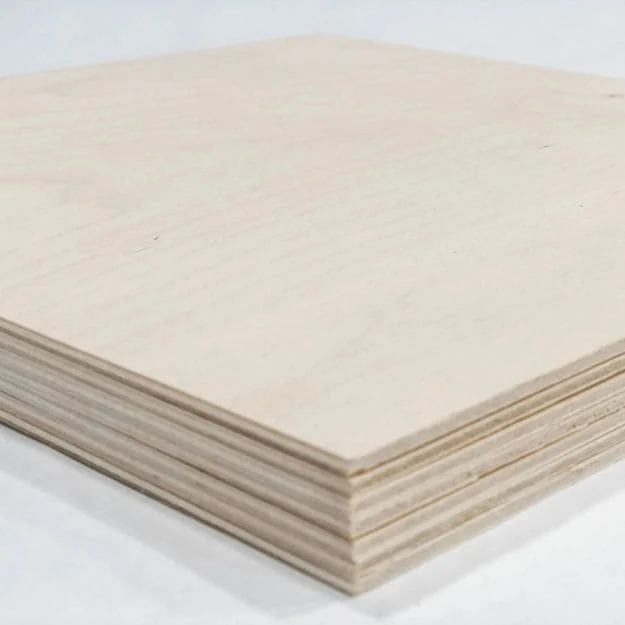
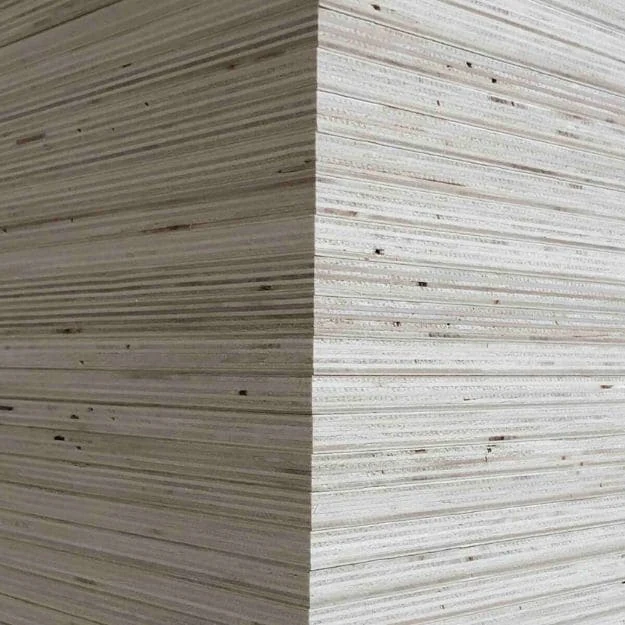
CUZI Commercial and Birch Plywood are available in 3–30 mm with poplar, birch or eucalyptus core options, BB/CC or C/D face/back grades and E0/E1 emission options. Commercial supply also supports a specified mixed-species lay-up. Keep the face/back species, inner veneers and finish together when asking for density or sheet mass.
Scroll horizontally to compare all columns.
| Construction to compare | Weight information to request | Keep in the component trial |
|---|---|---|
| Poplar-core plywood | Full layer schedule, actual dimensions, measured sheet mass and density/conditioning information. | Completed-unit handling target, selected face, joints, hardware and finish. |
| Birch core / birch throughout | Every inner species, veneer gauges, sheet mass and the documented density basis. | Exposed-edge appearance, routed details, fitting positions and required product properties. |
| Eucalyptus or combi core | Species by layer or the agreed sequence, dimensions and measured mass for that construction. | The same drawing, supports, fittings and finished-part requirements as the alternative. |
For each alternative, compare a quoted panel at the same format and thickness before comparing the completed unit. If one option needs more material, a changed joint or a different finish to meet the design, include those changes in the final weight and cost comparison.
Review Commercial Plywood, Birch Plywood and Poplar Core Plywood. The birch-faced and all-birch guide helps identify the inner construction behind a similar-looking surface.
Give similar-looking panels different material references.
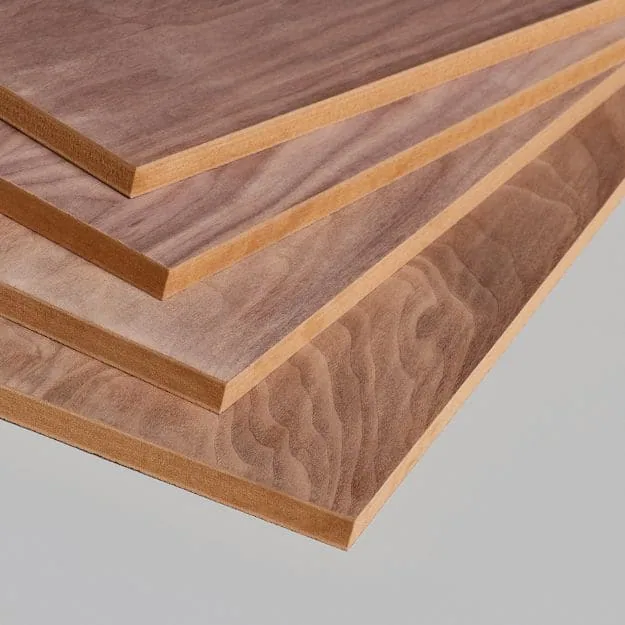
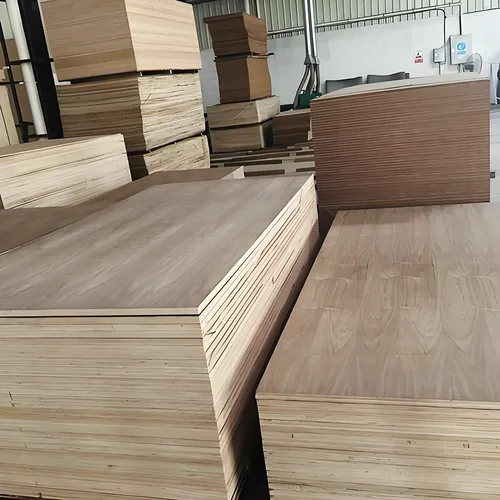
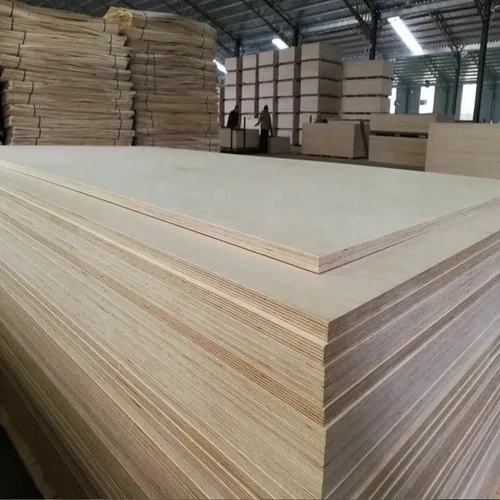
The photographs show a birch-faced panel and the stacked edges of poplar-core plywood. The face and cut edge help identify the construction discussion; the offered veneer schedule and measurement records identify the inner species and density. Keep those records beside the sheet size and gauge you want to compare.
For a combi core, name the species arrangement rather than assigning the whole board a single species-density assumption. Ask whether the supplied mass covers the bare panel or a film, facing or edge treatment too. Use the complete finished-panel data when that is the item being handled or shipped.
What does a plywood density value describe?
Density relates mass to volume. A panel value needs an identified construction and measurement basis: dimensions, moisture/conditioning, surface treatment, method and whether the number is a measured result or a declared planning value. Ask for the proposed range and the item it covers when comparing offers.
For a manufacturer example, WISA's size and weight guidance publishes different approximate densities for its birch and spruce products and identifies moisture conditions for its dimensional tolerances. Use the offered CUZI item's own data and dimensions when developing your schedule.
- Measured result
- Keep the sample/sheet identity, scale reading, dimensions, date, method and conditions with the value.
- Supplier planning data
- Identify the construction, range, nominal/actual dimension basis and conditions covered by the declared value.
- Your calculation assumption
- Name the density input and its source; replace an assumption with the proposed item's data as the order develops.
If you compare full-sheet mass with a density estimate, use a consistent dimensional basis. A value calculated from nominal volume can differ from a test result using measured dimensions. Record which basis each number uses so purchasing and logistics can reconcile the difference.
Use one dimensional basis for a density calculation.
Density arithmetic inputs: a chosen scale reading of 31.90 kg, nominal dimensions of 1220 × 2440 × 18 mm, and alternative dimensional readings of 1221 × 2441 × 17.80 mm. These numbers illustrate a measurement record and are not an actual CUZI sheet test.
Scroll horizontally to compare all columns.
| Dimension basis | Volume | Mass input | Calculated density |
|---|---|---|---|
| Nominal 1220 × 2440 × 18 mm | 0.0535824 m³ | 31.90 kg | 595.34 kg/m³ |
| Chosen readings 1221 × 2441 × 17.80 mm | 0.0530522058 m³ | 31.90 kg | 601.29 kg/m³ |
Divide the mass by the volume used in that line. The difference comes from the chosen dimensions, while the mass stays unchanged. Keep actual measurement locations, instrument information and conditioning with a real result. An estimate based on nominal dimensions should retain that label when compared with a reported density.
Convert the dimensions, then calculate area, volume and mass.
Divide millimetres by 1000 to obtain metres. For a rectangular sheet, length × width gives area in m²; area × thickness gives volume in m³. Multiplying that volume by density in kg/m³ gives estimated sheet mass in kg.
- Sheet area: length (m) × width (m).
- Sheet volume: length (m) × width (m) × thickness (m).
- Sheet mass estimate: sheet volume (m³) × density (kg/m³).
- Mass per area: thickness (m) × density (kg/m³), expressed in kg/m².
- Item net panel mass: per-sheet estimate × the ordered sheet count.
Keep the unrounded values when adding items; round the displayed result at the end. If density has not been supplied, you can still calculate area and volume. Request the construction's density or measured sheet mass to complete the weight line.
A kg/m² value needs its thickness. A kg/m³ value needs its construction and measurement basis. Include both units with the number so a surface weight cannot be mistaken for panel density.
Keep the unit conversions on the schedule.
A line using millimetres must convert all three dimensions before multiplying by kg/m³. Keep quantity separate from the per-sheet result. When copying figures between a purchase schedule and a packing list, retain the units and the item identity beside each number.
For a cut component, calculate the delivered geometry, including any material removed by openings or profiles where relevant. A rectangular blank calculation can be useful for the raw-material scope. The completed part weight should include the actual remaining board, face/reverse, coating, edging and fittings.
WORKED WEIGHT CALCULATION
How much does a 1220 × 2440 × 18 mm sheet weigh?
Planning assumptions: 18 mm nominal thickness and 600 kg/m³ density. These are calculation inputs; use the offered construction's dimensions and density for your order.
The dimensions convert to 1.22 × 2.44 × 0.018 m. Volume is 0.0535824 m³. Multiplying by the assumed density of 600 kg/m³ gives 32.14944 kg, displayed as 32.15 kg per sheet. The corresponding mass per area is 10.80 kg/m².
Scroll horizontally to compare all columns.
| Sheet format | Net volume per sheet | Estimated sheet mass | Estimated net mass, 100 sheets |
|---|---|---|---|
| 1220 × 2440 mm | 0.0535824 m³ | 32.15 kg | 3214.944 kg |
| 1250 × 2500 mm | 0.05625 m³ | 33.75 kg | 3375.000 kg |
| 1525 × 3050 mm | 0.0837225 m³ | 50.23 kg | 5023.350 kg |
For the first format, changing only the density assumption to 700 kg/m³ gives 37.51 kg per sheet and 3750.768 kg for 100 sheets. That adds 535.824 kg to the item. This sensitivity check shows why the density input deserves the same attention as thickness and sheet count.
CUZI's regular plywood formats are 1220 × 2440 mm, 1250 × 2500 mm and 1525 × 3050 mm. Requested formats include 1220 × 3050 mm, 1250 × 3660 mm and other dimensions. The sheet-size guide connects those formats with your cutting layout and finished-thickness requirement.
Check the effect of the inputs that remain open.
Sensitivity assumptions: a 1220 × 2440 mm sheet, with three chosen thickness and density combinations. These bounds illustrate an estimate; they are not CUZI supply tolerances or declared density ranges.
Scroll horizontally to compare all columns.
| Thickness input | Density input | Calculated sheet mass |
|---|---|---|
| 17.60 mm | 580 kg/m³ | 30.39 kg |
| 18.00 mm | 600 kg/m³ | 32.15 kg |
| 18.40 mm | 620 kg/m³ | 33.96 kg |
The chosen combinations span 3.57 kg per sheet when calculated from unrounded results. For 100 sheets the difference is 357.216 kg. Replace the inputs with the actual offered combination before using the estimate in a shipment discussion; the final packing and logistics review needs its corresponding measured information.
Give the weight result a panel identity.
Ask for sheet or bundle weight tied to the proposed SKU and lot. Include face/back and inner species, ply schedule, thickness, format and surface treatment. Request the scale/measurement method, conditions and the selection of sheets represented by the result.
For a component trial, record the raw blank and completed unit separately. Machining removes material; edging, coating and fittings add to the assembly. Weigh the unit in the condition your customer will handle, with the actual hardware and finish included.
The APA moisture-related dimensional-stability guidance describes how wood panels respond to environmental moisture. Keep moisture/conditioning and measured dimensions with your mass comparison, particularly when matching a new delivery with an older stored reference.
Use a small sample for the visible face, cut core and fitting trial. Request full-sheet or bundle mass information for loading calculations. Keep workshop observations and any required mechanical test result with the chosen construction; select strength, stiffness and fixing performance against their own component requirements.
Record what was on the scale.
Identify whether the reading covers one sheet, a stack or a packed bundle. Record the included surfaces and any packaging, plus the item count. Keep the date and relevant storage or conditioning information so a receiving comparison uses a traceable basis.
When dividing a stack mass by its sheet count, describe the result as an average for that identified selection. Retain any measured sheet range separately where it matters to your handling plan. Avoid mixing a net sheet average with a packed-bundle gross reading when comparing constructions.
ADD THE ITEMS BEFORE YOU ADD THE PACKING
Mixed sizes and cores need separate weight lines.
Worked schedule assumptions: Item A uses 600 kg/m³; Item B uses 650 kg/m³. Quantities, constructions and packing below are illustrative inputs for the calculation.
Scroll horizontally to compare all columns.
| Item and dimensions | Quantity and density input | Net panel volume | Estimated net panel mass |
|---|---|---|---|
| A · 1220 × 2440 × 18 mm | 100 sheets · 600 kg/m³ | 5.35824 m³ | 3214.944 kg |
| B · 1525 × 3050 × 12 mm | 80 sheets · 650 kg/m³ | 4.46520 m³ | 2902.380 kg |
| Panel total | 180 sheets across two items | 9.82344 m³ | 6117.324 kg |
Suppose the packing estimate is five bundles with 30 kg of packaging per bundle: packing adds 150 kg, taking the calculated packed cargo total to 6267.324 kg. These assumed bundles explain the arithmetic; request the actual sheet counts, external dimensions, tare and gross weights for the agreed packing.
Add further SKUs one line at a time. Keep a density source or measured-mass basis beside each construction, then sum the unrounded item values. The mixed-order SKU schedule helps tie that list to bundle and packing-list references.
If a packing list already gives the measured gross weight of each bundle, sum those gross weights for that scope. Use the net and tare columns for reconciliation so packaging is counted once.
Reconcile the packing addition once.
The two panel lines total 6117.324 kg before packing. The chosen five-bundle packaging addition is 150 kg, producing the stated 6267.324 kg packed-cargo calculation. Keep each bundle's item quantities and packaging scope beside the line so the receiving team can reconcile them.
If the finished packing record supplies bundle gross weights, use those readings for that scope. Do not add the same tare again. Record any separate securing material outside the bundles under its own line and keep container tare distinct from the cargo and packaging.
Carry the right weight into freight and unloading.
The schematics separate the weight scopes. For the shipment, obtain the actual bundle measurements and counts, then have the logistics provider review the selected equipment, route and unloading arrangement.
Scroll horizontally to compare all columns.
| Planning field | Request with the item or shipment | Use it for |
|---|---|---|
| Net panel mass | Measured or calculated result, construction, dimensions, density source and conditions. | Material comparison and reconciliation with packing weight. |
| Bundle gross and tare | Sheet count, packaging scope, measured gross mass and tare for each bundle. | Handling and total cargo mass; count packaging once. |
| External bundle dimensions | Length, width, height, bundle count and proposed arrangement. | Occupied space, access, stacking and securing review. |
| Equipment and route | Selected container, permitted loads, route/road constraints and unloading equipment. | A loading plan reviewed against the actual movement. |
For sea freight, packed cargo mass and packed-container gross mass have different scopes. The IMO packed-container mass guidance includes cargo, packing/securing materials and the container's tare in verified gross mass. Confirm the required weighing and documentation arrangements with the shipping parties.
At receiving, share the largest bundle dimensions and gross weights with the unloading team. Include the lifting/access arrangement and bundle identification in the delivery discussion. A complete packing proposal connects the purchasing schedule to the equipment available on arrival.
Pass a usable packing proposal to the logistics team.
Send gross bundle weights with external lengths, widths and heights, bundle count, lifting arrangement and unloading access. Include the largest and heaviest bundle explicitly when those affect equipment selection. Have the shipping and receiving teams review their actual equipment and route constraints with that proposal.
For the packed-container record, coordinate the required weighing method, responsible shipper, container identification and document deadline with the shipping parties. The article's net-panel calculations are a purchasing tool; the agreed shipment requires the applicable measured and documented mass scope.
Send a schedule that purchasing and logistics can both use.
Start each line with its SKU, face/back, full core schedule, grade, bond/emission requirements, dimensions and sheet count. Add the density source or measured sheet mass, its conditions and any completed-component handling target.
Then add the packing proposal: sheets per bundle, bundle dimensions, tare/gross weights, protection, labelling and receiving constraints. Keep net panel volume and packed volume in separate columns. The panel-volume and loading guide explains that geometry alongside your weight schedule.
CUZI orders start at one container and can combine panel items in mixed loads. Regular production takes 10–15 days; shipping time is additional. Name the FOB or CIF port and target receiving date with the item list to discuss product quantities, packing and transport together.
Bring a weight target early when it affects the furniture design or handling route. Include the drawing, hardware, finishing scope and required mechanical performance so the proposed construction can be evaluated as a complete component.
Connect a change of construction with its weight line.
If purchasing changes a core, thickness, format or facing, update the affected mass basis and packing proposal with the item. If production changes the component geometry or hardware, update the completed-unit target too. Keep the old and revised references identifiable during the comparison.
At receiving, match bundle references, dimensions, quantities and the supplied mass records to the purchase schedule. Retain any observed difference with the measurement conditions and affected item so supplier, buyer and logistics contacts can address the same delivery.
Get the construction data, then build your weight schedule.
Request density and measured-mass information for the proposed Commercial or Birch Plywood item. Include dimensions, full lay-up, surface treatment and your use. Keep the measurement conditions and packing scope with the answer.
Use the worked 100-sheet dimensions and density assumption as a starting point, then edit them for your actual item. The inquiry retains the density input and calculated net mass and asks you to identify their basis.
Need to compare the face, edge or fitting first? Request two birch constructions against the same drawing and finish, then ask for the corresponding full-sheet mass data. Samples are free; buyer pays freight, with a later-order freight credit by agreement.
Request the data for the exact item you plan to load.
Include face/back species, full core schedule, format, gauge and surface treatment with the density or sheet-mass request. Add the sheet quantities and any bundle-weight or completed-part target. Identify whether your proposed number is measured, declared by a supplier or chosen for preliminary planning.
Questions buyers ask about plywood density and weight
How do I calculate plywood sheet weight?
Multiply length, width and thickness in metres by the construction's density in kg/m³. The result is estimated net sheet mass in kg. Multiply by quantity, then add packing separately for the shipment scope.
How much does 18 mm plywood weigh?
It depends on format and density. A 1220 × 2440 × 18 mm sheet calculates to 32.15 kg at an assumed 600 kg/m³ or 37.51 kg at 700 kg/m³. Use the actual construction's data or measured sheet mass for your buying schedule.
Can I use one density for every poplar or birch core?
Request the value for the complete offered construction. Identify face/back and all inner species, gauges, moisture/conditioning, finish and dimensional basis with the density or sheet-mass result.
What is the difference between kg/m³ and kg/m²?
Kg/m³ expresses density by volume. Kg/m² expresses mass per area for a stated thickness. At the assumed 600 kg/m³ and 18 mm, the calculated areal mass is 10.80 kg/m².
Does a calculated sheet mass include film or other facing?
Identify the construction covered by the density input. Use finished-panel data for the complete faced product, or separately account for layers outside the stated basis. Request measured finished-sheet mass when that is the useful buying reference.
How do I calculate weight for a mixed plywood order?
Calculate each size, thickness, construction and quantity separately. Add the unrounded item masses, then add packing for the cargo scope. Use measured bundle gross weights directly when available and count included packaging once.
Can net panel volume tell me how many sheets fit in a container?
A loading plan also needs external bundle dimensions, gross weights, equipment limits, route and securing arrangement. Ask the logistics provider to review the actual packing proposal and transport.
What should I send CUZI for a weight-focused quotation?
Send the SKU list, full construction, grade, dimensions, quantities, density or mass basis, component drawing/handling target and named FOB/CIF port. Add packing and unloading requirements so the material and shipment can be discussed together.